Jan
-
01/06/26
Junchen Zhao - Texas A&M University
Free products and rescalings involving non-separable abelian von Neumann algebras
AbstractFor a self-symmetric tracial von Neumann algebra $A$, we study rescalings of $A^{*n}*L\mathbb F_r$ for $n\in\mathbb N$ and $r\in (1,\infty]$ and use them to obtain an interpolation $\mathcal F_{s,r}(A)$ for all real numbers $s > $0 and $1 − s < r \leq\infty$. In this talk, I will first review the literature around this topic and explain well-definedness of the family $\mathcal F_{s,r}(A)$. I will discuss our definition of self-symmetry which includes all diffuse abelian tracial von Neumann algebras regardless of separability, and then focus on free products of infinitely many members of the family $\mathcal F_{s,r}(A_i)$. This is joint work with Ken Dykema.
-
01/06/26
Dr. Liding Yao - Purdue University Fort Wayne
The Newlander-Nirenberg Theorem below $C^{1/2}$
AbstractThe celebrated Newlander-Nirenberg theorem states that on a smooth manifold, an almost complex structure $J$ is a complex structure if and only if it is integrable, namely, the Nijenhuis tensor $N_J$ vanishes. It was known from Hill and Taylor that if $J$ has Hölder regularity above $C^{1/2}$ then $N_J$ makes sense as a tensor with distributional coefficients. However $N_J$ is undefined for generic $C^{1/2}$ tensor due to the failure of multiplication for $C^{1/2}$ functions and $C^{-1/2}$ distributions.
In the talk, we will explore the integrability condition when $J$ has regularity below $C^{1/2}$. We give a necessary and sufficient condition for $J$ being a complex structure (at least) for $J\in C^{1/3+}$ using Bony's paradifferential calculus.
This is an in progress work joint with Gennady Uraltsev.
-
01/08/26
Dr. Robert Weber - UCSD
Randomly sparsified Richardson iteration: A dimension-independent sparse linear solver
AbstractRecently, a class of algorithms combining classical fixed-point iterations with repeated random sparsification of approximate solution vectors has been successfully applied to eigenproblems with matrices as large as 10^108 x 10^108. So far, a complete mathematical explanation for this success has proven elusive. The family of methods has not yet been extended to the important case of linear system solves. Our recent work proposes a new scheme based on repeated random sparsification that is capable of solving sparse linear systems in arbitrarily high dimensions. We provide a complete mathematical analysis of this new algorithm. Our analysis establishes a faster-than-Monte Carlo convergence rate and justifies use of the scheme even when the solution is too large to store as a dense vector.
-
01/09/26
Ryan Schneider - UC Berkeley
Optimizing Jacobi's Method for the Symmetric Eigenvalue Problem
AbstractJacobi's method is the oldest-known algorithm for the symmetric eigenvalue problem. It is also optimal; depending on the implementation, Jacobi can (1) compute small eigenvalues to higher relative accuracy than any other algorithm and (2) attain the arithmetic/communication complexity lower bounds of matrix multiplication (in both serial and parallel settings). This talk surveys efforts to optimize Jacobi as a one-algorithm case study into recent trends in numerical linear algebra. Based on joint work with James Demmel, Hengrui Luo, and Yifu Wang.
-
01/09/26
Joel Tropp - Caltech
Randomized linear algebra with subspace injections
AbstractTo achieve the greatest possible speed, practitioners regularly implement randomized algorithms for low-rank approximation and least-squares regression with structured dimension reduction maps. This talk outlines a new perspective on structured dimension reduction, based on the injectivity properties of the dimension reduction map. This approach provides sharper bounds for sparse dimension reduction maps, and it leads to exponential improvements for tensor-product dimension reduction. Empirical evidence confirms that these types of structured random matrices offer exemplary performance for a range of synthetic problems and contemporary scientific applications.
Joint work with Chris Camaño, Ethan Epperly, and Raphael Meyer; available at arXiv:2508.21189. -
01/09/26
Dr. Hunter Dinkins - MIT
Enumerative 3d mirror symmetry of bow varieties
Abstract3d mirror symmetry predicts deep relationships between certain algebraic symplectic varieties. One such expectation is an "equivalence" between curve counts in a Higgs branch and those in the corresponding Coulomb branch. When it can be precisely formulated, this equivalence takes the form of an equality (after analytic continuation and change of variables) of meromorphic functions associated to the two branches. Bow varieties provide the largest currently known setting where the appropriate curve counts can be defined and their equivalence precisely formulated. In this talk, I will give an overview of these ideas and discuss my work with Tommaso Botta, in which we prove the duality of curve counts for finite type A bow varieties. Our proof combines geometric, combinatorial, and analytic arguments to eventually reduce to the case of the cotangent bundle of the complete flag variety. Time permitting, I will also discuss ongoing work to incorporate "descendant insertions" into the statements by using Hecke modifications of vector bundles.
-
01/12/26
Dr. Shubham Sinha - ICTP
A Borel-Weil-Bott theorem for Quot schemes on the projective line
AbstractThe cohomology groups of tautological bundles on Grassmannians are described by the celebrated Borel-Weil-Bott theorem. Quot schemes on the projective line provide a natural generalization of Grassmannians: they parametrize rank r quotients of a vector bundle V on the projective line. In this talk, I will present formulas for Euler characteristics and for the cohomology groups of tautological bundles on these Quot schemes. Additionally, I will describe how these formulas apply to the study of the quantum K-theory of Grassmannians.
-
01/13/26
Patrick DeBonis - Purdue University
The W* and C*-algebras of Similarity Structure Groups
AbstractCountable Similarity Structure (CSS) groups are a class of generalized Thompson groups. I will introduce CSS$^*$ groups, a subclass, that we prove to be non-acylindrically hyperbolic, that includes the Higman-Thompson groups $V_{d,r}$, the countable R\"over-Nekrashevych groups $V_d(G)$, and the topological full groups of subshifts of finite type of Matui. I will discuss how all CSS$^*$ groups give rise to prime group von Neumann algebras, which greatly expands the class of groups satisfying a previous deformation/rigidity result. I will then discuss how CSS$^*$ groups are either C$^*$-simple with a simple commutator subgroup, or lack both properties. This extends C$^*$-simplicity results of Le Boudec and Matte Bon and recovers the simple commutator subgroup results of Bleak, Elliott, and Hyde. This is joint work with Eli Bashwinger.
-
01/14/26
Prof. Nguyen-Truc-Dao Nguyen - SDSU
Optimization Using Model Predictive Control Combined with iLQR and Neural Networks
AbstractThis talk is devoted to combining model predictive control (MPC) and deep learning methods, specifically neural networks, to solve high-dimensional optimization and control problems. MPC is a popular method for real-life process control in various fields, but its computational requirements can often become a bottleneck. In contrast, deep learning algorithms have shown effectiveness in approximating high-dimensional systems and solving reinforcement learning problems. By leveraging the strengths of both MPC and neural networks, we aim to improve the efficiency of solving MPC problems. The talk also discusses the optimal control problem in MPC and how it can be divided into smaller time horizons to reduce computational costs. Additionally, we focus on enhancing MPC through two approaches: a machine learning–based feedback controller and a machine learning–enhanced planner, which involve implementing neural networks and iLQR. Overall, this talk provides insights into the potential of combining MPC and deep learning methods to tackle complex control problems across various fields, with applications to robotics.
-
01/15/26
Guillaume Blanc - EPFL
Random burning of the Euclidean lattice
AbstractThe burning number of a graph is the minimal number of steps that are needed to burn all of its vertices, with the following procedure: at each step, one can choose a point to set on fire, and the fire propagates constantly at unit speed along the edges of the graph. In joint work with Alice Contat, we consider two natural random burning procedures in the discrete Euclidean torus with side-length n, in which the points that we set on fire at each step are random variables. Our main result deals with the case where at each step, the law of the new point that we set on fire conditionally on the past is the uniform distribution on the complement of the set of vertices burned by the previous points. In this case, we prove that as n tends to infinity, the corresponding random burning number (i.e, the first step at which the whole torus is burned) is asymptotic to T times n^{d/(d+1)} in probability, where T is the explosion time of a so-called generalised Blasius equation.
-
01/15/26
Dr. Lijun Ding - UCSD
On the squared-variable approach for nonlinear (semidefinite) programming
AbstractConsider min f(x) s.t. x>=0, where the objective function f: R→ R is smooth, and the variable is required to be nonnegative. A naive "squared variable" technique reformulates the problem to min_v f(v^2). Note that the new problem is now unconstrained, and many algorithms, e.g., gradient descent, can be applied. In this talk, we discuss the disadvantages of this approach, which have been known for decades, and the possible surprising fact of equivalence for the two problems in terms of (i) local minimizers and (ii) points satisfying the so-called second-order optimality conditions, which are keys for designing optimization algorithms. We further discuss extensions of the approach and equivalence to the vector case (where the vector variable is required to have all entries nonnegative) and the matrix case (where the matrix variable is required to be a positive semidefinite).
-
01/15/26
Professor Tom Hutchcroft - Caltech
Critical long-range percolation
AbstractIt is conjectured that many models of statistical mechanics have a rich, fractal-like behaviour at and near their points of phase transition, with power-law scaling governed by critical exponents that are expected to depend on the dimension but not on the small-scale details of the model such as the choice of lattice. This is now reasonably well understood in two dimensions and in high dimensions, but remains poorly understood in intermediate dimensions (e.g. d=3). I will overview the conjectures around this area and describe recent progress on related problems for models with long-range interactions.
-
01/16/26
Dr. Yinbang Lin - University of Houston
Expected behaviors of sheaves on algebraic surfaces
AbstractMotivated by the Brill--Noether problems and enumerative geometry over surfaces, we study the expected behaviors of coherent sheaves. We estimate the dimension of global sections of stable sheaves. We also prove some cases of an analogue of Lange's conjecture over curves, which states that general extensions of two vector bundles are stable under some obvious conditions. These are closely related to Segre invariants of sheaves, which studies maximal subsheaves of a fixed rank. This can be understood as to determine when Grothendieck's Quot schemes are non-empty. This is based on work in progress jointly with Thomas Goller and Zhixian Zhu.
-
01/20/26
Amos Nevo - University of Chicago/Technion
Analysis on spaces with exponential volume growth
AbstractWe consider ball averages on discrete groups, and associated Hardy-Littlewood maximal operator, with the balls defined by invariant metrics associated with a variety of length functions. Under natural assumptions on the rough radial structure of the group under consideration, we establish a maximal inequality of weak-type for the Hardy-Littlewood operator. These assumptions are related to a coarse radial median inequality, to almost exact polynomial-exponential growth of balls, and to the rough radial rapid decay property. We give a variety of examples where the rough radial structure assumptions hold, including any lattice in a connected semisimple Lie group with finite center, with respect to the Riemannian distance on symmetric space restricted to an orbit of the lattice. Other examples include right-angled Artin groups, Coxeter groups and braid groups, with a suitable choice of word metric. For non-elementary word-hyperbolic groups we establish that the Hardy-Littlewood maximal operator with respect to balls defined by a word metric satisfies the weak-type (1,1)-maximal inequality, which is the optimal result. This is joint work with Koji Fujiwara, Kyoto University.
-
01/20/26
Finn Southerland - UCSD
Region counting on another level
AbstractHyperplane arrangements cut space into `regions', which we like to count. Although all regions are $n$-dimensional, some are more bounded than others, captured by the `level' of a region. Can we refine our region counting by level? And how do level counts interact with other properties of the arrangement? This talk should be highly approachable, requiring only the ability to visualize high-dimensional objects.
-
01/20/26
Zion Hefty - University of Denver
Improving Ramsey R(3,k) in just two bites
AbstractThe Ramsey number R(t, k) is the smallest n such that any red-blue edge coloring of the n-vertex complete graph has either a t-vertex red complete subgraph or a kvertex blue complete subgraph. We will investigate the history of asymptotic bounds on the extreme off-diagonal Ramsey number R(3, k), and present a new lower bound that has been conjectured to be asymptotically tight. Based on joint work with Paul Horn, Dylan King, Florian Pfender.
-
01/22/26
Professor Amos Nero - University of Chicago/Technion
New directions and some effective optimal results in Diophantine approximation on homogeneous spaces
AbstractOur set up will consist of a countable group acting on a metric space with dense orbits. Our goal will be to develop effective gauges that measure how dense such orbits actually are, or equivalently how efficient is the approximation of a general point in the space by the points in the orbit. We will describe several such gauges, whose definitions are motivated by classical Diophantine approximation, and are related to approximation exponents, discrepancy and equidistribution. We will then describe some of the (non-classical) examples we aim to analyze, focusing mainly on certain countable subgroups of the special linear or affine group, or of the groups of isometries of hyperbolic spaces, acting on some associated homogeneous spaces. In this set-up it is possible to establish optimal effective Diophantine approximation results in certain cases. We will very briefly indicate some ingredients of the methods involved, keeping the exposition as accessible as possible. We will also indicate some of the many challenging open problems that this circle of questions present. Based partly on previous joint work with Anish Ghosh and Alex Gorodnik, and partly on recent work with Mikolaj Fraczyk and Alex Gorodnik.
-
01/23/26
Matt Jacobs - UCSB
TBD
-
01/23/26
-
01/27/26
Ning Tang - UC Berkeley
Global asymptotics for the Schrödinger equation with variable coefficients
AbstractIn this talk, I will discuss a new physical-space approach to establishing the time decay and global asymptotics of solutions to variable-coefficient Schrödinger equation in (3+1)-dimensions. The result is applicable to possibly large, time-dependent, complex-valued coefficients under a general set of hypotheses. As an application, we are able to handle certain quasilinear cubic and Hartree-type nonlinearities, proving global existence together with global asymptotics. I will begin with a model problem and describe the construction of a good commutator. Time permitting, I will explain how to incorporate the good commutator with Ifrim--Tataru the method of testing by wave packets to obtain global asymptotics. This talk is based on upcoming work with Sung-Jin Oh and Federico Pasqualotto.
-
01/27/26
Ben Major - UCLA
New Proofs of Indecomposability Results for Tracial von Neumann Algebras
AbstractWe show that, for many choices of finite tuples of generators $\mathbf{X}=(x_1,\dots,x_d)$ of a tracial von Neumann algebra $(M,\tau)$ satisfying certain decomposition properties (non-primeness, possessing a Cartan subalgebra, or property $\Gamma$), one can find a diffuse, hyperfinite subalgebra in $W^*(\mathbf{X})^\omega$ (often in $W^*(\mathbf{X})$ itself), such that $W^*(N,\mathbf{X}+\sqrt{t}\
mathbf{S})=W^*(N,\mathbf{X},\ mathbf{S})$ for all $t>0$. (Here $\mathbf{S}$ is a free semicircular family, free from $\{\mathbf{X}\cup N\}$). This gives a short 'non-microstates' proof of strong 1-boundedness for such algebras. This is joint work with Dimitri Shlyakhtenko.
-
01/27/26
Tiklung Chan - UCSD
Tubey or not tubey?
AbstractThat is the question. In this talk, I will describe several problems of varying degrees of “tubiness” (the amenability of the problem to tube technology).
-
01/27/26
Finn Southerland - UCSD
Region counting on another level
AbstractThe number of regions of a hyperplane arrangement is a well-understood invariant, which we can complicate by counting regions of a given \emph{level}, a statistic quantifying a region's boundedness. Rediscovering a formula of Zaslavsky, we show that the level distribution is a \emph{combinatorial invariant}, and in the process define it for all semimatroids. The formula also allows us to reprove and generalize many known results on deformations of the braid arrangement.
-
01/29/26
Yujin Kim - Caltech
Absolute continuity of non-Gaussian and Gaussian multiplicative chaos measures
AbstractGaussian multiplicative chaos (GMC) is a well-studied random measure appearing as a universal object in the study of Gaussian or approximately Gaussian log-correlated fields. On the other hand, no general framework exists for the study of multiplicative chaos associated to non-Gaussian log-correlated fields. In this talk, we examine a canonical model: the log-correlated random Fourier series, or random wave model, with i.i.d. random coefficients taken from a general class of distributions. The associated multiplicative chaos measure was shown to be non-degenerate when the inverse temperature is subcritical ($\gamma < \sqrt{2d}$) by Junnila. The resulting chaos is easily seen to not be a GMC in general, leaving open the question of what properties are shared between this non-Gaussian chaos and GMC. We answer this question through the lens of absolute continuity, showing that there exists a coupling between this chaos and a GMC such that the two are almost surely mutually absolutely continuous.
-
01/29/26
Prof. Pearson Miller - UCSD
Optimal control of weakly nonlinear pattern formation
AbstractThis talk will present new results on the optimal control of self-organization, motivated by a growing body of empirical work on biological pattern formation in dynamic environments. We pose a boundary control problem for the classic supercritical Turing pattern, asking the best way to reach a non-trivial steady state by controlling the boundary flux of a reactant species. Via the Pontryagin approach, first-order optimality conditions for a generic reaction-diffusion system with a suitable bifurcation structure are derived. Using formal asymptotics, we construct approximate closed-form optimal solutions in feedback law form that are valid for any Turing-unstable system near criticality, which are verified against numerical solutions for a representative reaction-diffusion model.
-
01/29/26
Prof. Dragos Oprea - UCSD
Curves, abelian varieties and their moduli
AbstractAlgebraic curves and abelian varieties play a central role in modern algebraic geometry, with links to complex analysis, number theory, topology and others. Curves and abelian varieties are closely related: a fundamental example of an abelian variety is the Jacobian of an algebraic curve. In this talk, I will give a discussion of curves, abelian varieties and their moduli spaces. Time permitting, I will present some new tools aimed at studying geometric classes on the moduli space of abelian varieties, and conclude with a discussion of several open questions in this area.
Feb
-
02/02/26
Lillian McPherson - UC San Diego
The algebra of symmetric tensors for ruled surfaces
-
02/02/26
Nick Kariss - UCSD
The Best* Theorem in Linear Algebra
AbstractLinear algebra is the workhorse of modern data science and machine learning, but none of the fun applications are ever mentioned in Math 18. We remedy this by discussing Principal Component Analysis,,the best* of these applications, and show how it follows quickly from the Singular Value Decomposition, the best* theorem in linear algebra. We present a few mathematical perspectives, explain the equivalent formulations of PCA, and ultimately use PCA to build an elementary image classifier without any fancy tools from machine learning.
*The speaker does not necessarily believe any of these claims but will nonetheless defend them vehemently if heckled.
-
02/02/26
Casey Perdue
On the saturability of p-adic Lie groups
AbstractThe study of p-adic Lie groups and their representations is a central piece of the p-adic Langlands program. One tool which is used to study these is the notion of a saturated pro-p group, and the famous result of Lazard which states that every p-adic Lie group contains an open saturable subgroup. In this talk, we will demonstrate a family of open saturated subgroups of G(F) for G a reductive group over a p-adic field F, which is indexed by the semisimple Bruhat-Tits building of G, given a mild assumption on G. We will then review some group-theoretic consequences of this result.
-
02/02/26
Professor Meltem Altun Ozarslan - UC Irvine; Hacettepe University
Finite versus Full Exchange: Theory and Open Problems
AbstractThe exchange property, introduced by Crawley and Jonsson in 1964 in the study of direct decompositions of algebraic systems and later extended to modules and rings by Warfield, plays a central role in modern decomposition theory. One of the main open problems in the area is whether the finite exchange property implies the full exchange property. This talk surveys the development of exchange theory from its module-theoretic origins to its ring-theoretic formulation via exchange rings. The last part of the talk is based on joint work with A. Cigdem Ozcan and focuses on lifting theory, including idempotent, regular, and unit lifting ideals and morphisms, and their interaction with local morphisms.
-
02/02/26
Dr. Artan Sheshmani - BIMSA
Tyurin degenerations, Relative Lagrangian foliations and categorification of DT invariants
AbstractWe discuss construction of a derived Lagrangian intersection theory of moduli spaces of perfect complexes, with support on divisors on compact Calabi-Yau threefolds. Our goal is to compute deformation invariants associated to a fixed linear system of divisors in CY3. We apply a Tyurin degeneration of the CY3 into a normal-crossing singular variety composed of Fano threefolds meeting along their anti-canonical divisor. We show that the moduli space over the Fano 4 fold given by total space of the degeneration family satisfies a relative Lagrangian foliation structure which leads to realizing the moduli space as derived critical locus of a global (-1)-shifted potential function. We construct a flat Gauss-Manin connection to relate the periodic cyclic homology induced by matrix factorization category of such function to the derived Lagrangian intersection of the corresponding “Fano moduli spaces”. The latter provides one with categorification of DT invariants over the special fiber (of degenerating family). The alternating sum of dimensions of the categorical DT invariants of the special fiber induces numerical DT invariants. If there is time, we show how in terms of “non-derived” virtual intersection theory, these numerical DT invariants relate to counts of D4-D2-D0 branes which are expected to have modularity property by the S-duality conjecture. This talk is based on joint work with Jacob Krykzca.
-
02/03/26
Yuan Hui
Advancement to Candidacy
-
02/03/26
Isaiah Siegl - University of Washington
Upper and lower bounds for the $e$-coefficients of chromatic symmetric functions
AbstractIn 2024, Hikita showed that the chromatic symmetric functions of incomparability graphs of (3+1)-free posets expand with positive coefficients in the basis of elementary symmetric functions. This result resolved the long-standing Stanley–Stembridge conjecture. Finding a combinatorial interpretation of the $e$-coefficients remains a major open problem. In this talk I will define powerful and strong $P$-tableaux and conjecture that they give upper and lower bounds for the $e$-coefficients of chromatic symmetric functions. As evidence for these conjectures, we obtain combinatorial interpretations for various e-coefficients which live in between strong and powerful $P$-tableaux. Additionally, we show how Hikita’s theorem relates to strong $P$-tableaux and the Shareshian–Wachs inversion statistic.
-
02/05/26
Shuncheng Yuan
Rational From Complex Fast Matrix Multiplication
-
02/05/26
Evgeni Dimitrov - USC
Line ensembles in symmetrized geometric last passage percolation
AbstractIn this talk, I will discuss symmetrized geometric last passage percolation. This is a prototypical model in the half-space KPZ universality class that has a natural interpretation as a line ensemble (a collection of random continuous functions). The model depends on parameters q,c, which control the background noise strength away from and at the boundary of the model, respectively. Depending on whether c < 1(subcritical), c = 1(critical), or c> 1(supercritical), the model exhibits different asymptotic behavior, and I will discuss some recent progress in understanding this from a line ensemble perspective.
-
02/05/26
Prof. Melvin Leok - UCSD
Geometric Mechanics and Geometric Integrators for Control, Optimization, and Sensitivity Analysis
AbstractThe geometric approach to mechanics serves as the theoretical underpinning of innovative control methodologies in geometric control theory. These techniques allow the attitude of satellites to be controlled using changes in its shape, as opposed to chemical propulsion, and are the basis for understanding the ability of a falling cat to always land on its feet, even when released in an inverted orientation.
We will discuss the application of geometric structure-preserving numerical schemes to the geometric optimization control of mechanical systems, such as robots and drones. I will also describe the role of geometry and geometric structure-preservation in accelerated optimization and adjoint sensitivity analysis, and how they can be used to train neural networks derived from neural differential equations.
-
02/05/26
Professor Ferdinand Ihringer
The Structure of Large Intersecting Families in Vector Spaces
AbstractThe classical EKR theorem states that the largest intersecting family of k-uniform subsets of an n-element set consists of all k-sets through a fixed element. More generally, it is known that large intersecting families are locally concentrated. So far such characterization results are missing for intersecting families of subspaces in vector. We will describe ongoing work which closes this gap in the literature. Joint work with Andrey Kupavskii.
-
02/05/26
Govind Menon - Brown University
Towards a geometric theory of deep learning
AbstractThe mathematical core of deep learning is function approximation by neural networks trained on data using stochastic gradient descent. I will explain an emerging geometric framework for the analysis of this process. This includes a collection of rigorous results on training dynamics for the deep linear network (DLN) as well as general principles for arbitrary neural networks. The mathematics ranges over a surprisingly broad range, including geometric invariant theory, random matrix theory, and minimal surfaces. However, little background in these areas will be assumed and the talk will be accessible to a broad audience. The talk is based on joint work with several co-authors: Yotam Alexander, Nadav Cohen (Tel Aviv), Kathryn Lindsey (Boston College), Alan Chen, Zsolt Veraszto and Tianmin Yu (Brown).
-
02/09/26
Suhas Gondi - UC San Diego
Border Rank Lower Bounds for Families of GL(V)-invariant Tensors
AbstractThe border rank of tensors is a widely studied topic with practical applications to theoretical computer science and algebraic statistics. New lower bounds were obtained for the matrix multiplication tensor using techniques from representation theory and algebraic geometry. In this talk, we will prove non-trivial border rank lower bounds for a class of GL(V)-invariant tensors using Young flattenings. We will see how this comes down to proving results on ranks of certain maps between schur functors, the proofs of which surprisingly uses deep results in representation theory and commutative algebra.
-
02/10/26
Paolo Leonetti - Università degli Studi dell'Insubria
Orbits Which Are “More Than” Dense
AbstractLet $T: X\to X$ be a continuous map, where $X$ is a topological space. Fix also a family $\mathsf{I}\subseteq 𝒫(\mathbb{N})$ of "small" sets of nonnegative integers (for instance, the family $\mathrm{Fin}$ of finite sets, or the family $\mathsf{Z}$ of asymptotic density zero sets). A point $x \in X$ is said to be $\mathsf{I}$-hypercyclic if
$$
\{n \in \mathbb{N}: T^nx \in U\}\notin \mathsf{I}
$$
for each nonempty open $U\subseteq X$. On a similar direction, a point $x \in X$ is said to be $\mathsf{I}$-strong hypercyclic if for each $y \in X$ there exists a subsequence $(T^nx: n \in A)$ of its orbit which is convergent to $y$ and, in addition, the set of indexes $A$ is \textquotedblleft not small,\textquotedblright\, that is, $A\notin \mathsf{I}$. In both cases, if $\mathsf{I}=\mathrm{Fin}$ and $X$ is a sufficiently nice topological space, then $x$ is $\mathsf{I}$-hypercyclic iff it is $\mathsf{I}$-strong hypercyclic iff its orbit is dense.We provide several structural relationships between the above notions and the related ones of recurrence with respect to $\mathsf{I}$. None of our results relies on the full linearity of $T$. As applications, we show that if $T$ is a homomorphism on a Fréchet space $X$ and there exists a dense set of vectors with orbits convergent to $0$, then for each $y \in X$ the set of all vectors $x \in X$ such that $\lim_{n \in A}T^nx=y$ for some $A\notin \mathsf{Z}$ is either empty or comeager. In a special case of bounded linear operators on Banach spaces, we obtain that $T$ is $\mathsf{Z}$-hypercyclic if and only if there exists a hypercyclic vector $x \in X$ for which $\lim_{n \in A}T^nx=0$ for some $A\notin \mathsf{Z}$. We conclude with several open questions.
-
02/10/26
Connor McCausland - University of Washington
Pipe Dreams and Rubey's Lattice Conjecture
AbstractReduced pipe dreams are combinatorial objects that encode some of the algebraic, enumerative, geometric, and probabilistic properties of Schubert and Grothendieck polynomials. They were introduced in 1993 by Bergeron and Billey, who showed that the set of all reduced pipe dreams for a fixed permutation w has a natural poset structure, with covering relations given by simple local operations called chute and ladder moves. In 2011, Rubey generalized chute and ladder moves on the set of reduced pipe dreams for a permutation w, and he conjectured that the induced poset on reduced pipe dreams is a lattice. We prove this conjecture and give simple recursive formulas for joins and meets in Rubey's lattice. This talk is based on joint work with Sara Billey and Clare Minnerath.
-
02/12/26
Professor Fang Wang - Shanghai Jiao Tong University
Poincare Einstein Manifolds and Fractional GJMS Operators
AbstractThe fractional GJMS operators form a one-parameter family of conformally invariant operators defined on the conformal infinity of a Poincare-Einstein manifold. We mainly focus on operators of order between 0 and 2. First, I will show that the associated fractional Yamabe constants provide lower bounds for the relative volume of geodesic balls in the interior. Then, I will present some monotonicity properties for this family of fractional Yamabe constants. Finally, I will introduce some recent progress on the positive mass theorem for these fractional GJMS operators. This is joint work with Huihuang Zhou.
-
02/12/26
Prof. Antonio Sanchez - UCSD
Reduced-order modeling of drug dispersion in the spinal canal
AbstractOptimizing intrathecal drug delivery procedures requires a deeper understanding of flow and transport in the spinal canal. Numerical modeling of drug dispersion is challenging because of the strong separation of time scales: dispersion occurs over approximately one hour, whereas cerebrospinal fluid pulsations driven by cardiac motion occur on a time scale of about one second. Patient-specific predictions in clinical settings therefore call for simplified descriptions that focus on dispersion time scales while bypassing the rapid concentration oscillations induced by cyclic motion. We show how asymptotic methods that exploit this separation of time scales can be used to derive a reduced transport equation in which convective transport driven by the mean Lagrangian drift governs drug dispersion. The model is validated through comparisons with MRI-informed direct numerical simulations of drug dispersion in a cervical spinal canal geometry that includes nerve rootlets and denticulate ligaments. These comparisons demonstrate that the reduced model accurately captures drug transport while enabling dispersion predictions at a fraction of the computational cost required by direct numerical simulations.
-
02/12/26
Prof. Michael Krivelevich - Tel Aviv University
Combinatorial conditions for graph rigidity, with applications to random graphs
AbstractGraph rigidity is one of the most classical subjects in graph theory, studying geometric properties of graphs. Formally, a graph $G=(V,E)$ is $d$-rigid if a generic embedding of its vertex set $V$ into $R^d$ is rigid, namely, every continuous motion of its vertices preserving the lengths of the edges of $G$ necessarily preserves all pairwise distances between the vertices of $G$.
We develop a new sufficient condition for d-rigidity, formulated in graph theoretic terms. This condition allows us to obtain several newresults about rigidity of random graphs. In particular, we argue that for edge probability $p>2\ln(n)/n$, a random graph $G(n,p)$ is with high probability (whp) $cnp$-rigid, for $c>0$ being an absolute constant. We also show that a random r-regular graph $G_{n,r}$, $r>=3$, is whp $cr$-rigid. Another consequence is a sufficient condition for $d$-rigidity based on the minimum co-degree of the graph.
The talk should be accessible to a general graph theoretic audience, no previous experience (whether positive or negative) with graph rigidity will be assumed.
A joint work with Alan Lew and Peleg Michaeli.
-
02/12/26
Prof. Ioana Dumitriu - UCSD
Spectra of sparse random matrices and applications
AbstractRandom matrix theory is a very broad and well-developed research area at the intersection of physics, statistics, probability and combinatorics (and arguably others). Applications range from numerical analysis to engineering, to biology, economics, signal processing and machine learning. Classically, the type of matrices that have been studied have certain invariance properties (e.g., orthogonal), and therefore are mostly dense; however, the last decade has been marked by a tremendous increase in sparse applications, particularly related to the ubiquity of sparse networks and graphs. This, in turn, has led to rapid development of sparse random matrix theory. Some spectral properties (eigenstatistics) of sparse matrices turn out to match the dense ones, but others generate new and interesting phenomena. I will provide a high-level perspective on this rapidly evolving field, and describe some applications of interest.
-
02/12/26
Dave Penneys - Ohio State University
Local topological quantum codes
AbstractQuantum information is encoded in a state vector of a tensor product of Hilbert spaces. Quantum error correction codes are useful for correcting errors when transporting quantum information through a noisy channel. In this talk, we will discuss a family of 2D "local topological" quantum error correction codes which use the robustness of topology to deformation to protect quantum information. We will then explain how operator algebra and tensor category techniques can be used to analyze quasi-particle excitations called anyons.
-
02/13/26
Thomas Madden - UCSD
Acceleration with large gradient steps via the proximal bundle method
AbstractThe proximal bundle method (PBM) is a powerful and widely used approach for minimizing nonsmooth convex functions. For smooth objectives, its best-known convergence rate has remained suboptimal. We present the first accelerated proximal bundle method to achieve the optimal O(1/sqrt(epsilon)) iteration complexity. The proposed method is conceptually simple, differing from Nesterov's accelerated gradient descent by a single line, and preserving the key structural properties of the classical PBM. As a result, we obtain an accelerated algorithm with much broader stepsize selection than what is allotted by accelerated gradient descent. The talk will include many pictures and numerical simulations to motivate algorithm design and illustrate fast convergence, respectively.
-
02/13/26
Justine Dell
Advancement to Candidacy
-
02/13/26
Ryan Y. Batubara - UCSD
On the universality of comparability grids for measurement-based quantum computation
-
02/17/26
Bill Helton - UCSD
Parallelizing a Class of Quantum Algorithms
AbstractMany classical computer algorithms can be paralyzed efficiently; what about quantum computers? An algorithm can be described as having layers, one composed with another, with the depth n of the circuit being the number of layers. An algorithm might be presented as having n simple layers, but if we are able to build more complicated layers, can we construct an equivalent algorithm with a few layers? This is an issue, which goes back to the early days when people became enthusiastic about the possibility of quantum computers.
One of the most straightforward test cases is called the quantum waterfall or quantum staircase. It is a tensor product analog of a matrix of 2 x 2 blocks supported on the diagonal and the first diagonal below it. It was conjectured in the late 90s that an n layer quantum waterfall cannot be produced with an algorithm having fewer than order n layers.
This conjecture (Moore-Nillson 1998) turns out to be way too pessimistic and the talk describes recent work with Adam Bene Watts, Joe Slote, Charlie Chen on a theorem constructing a parallelization of any n layer quantum waterfall which yields (asymptotically) log n layers. Gratifying to operator theorists is that a substantial ingredient is a matrix decomposition originating with Chandler Davis.
-
02/19/26
Dr. Dominic Skinner - Flatiron Institute
Accuracy, Stochasticity, and Information in Developmental Patterning
AbstractDevelopment reliably produces complex organisms despite external perturbations and intrinsic stochasticity. It remains a central challenge not only to understand specific examples of development in vivo, but also to infer underlying principles that extend beyond any particular model system. In this talk, we will first introduce the formation of dorsal branches in the Drosophila larval trachea as a model for structural developmental defects. In each branch, progenitor cells robustly organize themselves into distinct cell fates, driven by an external morphogen concentration. By perturbing the external signal, partially penetrant stochastic phenotypes emerge in which a variable number of "terminal" cells are specified. Using live imaging to capture both morphology and expression of key genes, we observe dynamically how successful fate patterning occurs and how it fails. Partially penetrant phenotypes are modeled by geneticists using "threshold-liability", a phenomenological model with unspecified molecular details. Here, we are able to connect the abstract model to the molecular implementation by directly measuring receptor activation. Next, we consider self-organization theoretically by introducing a minimal model of cell patterning via local cell-cell communication. Recent advances have clarified how isolated cells can respond to an exogenous signal, but cells often interact and act collectively. In our framework we prove that a trade-off between speed and accuracy of collective pattern formation exists. Moreover, for the first time we are able to quantify how information flows between interacting cells during patterning. Our analysis reveals counterintuitive features of collective patterning: globally optimized solutions do not necessarily maximize intercellular information transfer and individual cells may appear suboptimal in isolation.
-
02/19/26
Prof. Jacques Verstraete - UCSD
Combinatorial Nullstellensatz
AbstractThe combinatorial nullstellensatz was discovered by Noga Alon in 1995, and has since become an important tool in a variety of areas of mathematics. I will discuss this theorem and some of its numerous applications to Additive Number Theory, Geometry, and Combinatorics.
-
02/20/26
TBD
TBD
-
02/23/26
Urshita Pal - University of Michigan, Ann Arbor
The generalized Lee--Szczarba conjecture on the cohomology of principal congruence subgroups
AbstractI will discuss the rational cohomology of $SL_n(R), Sp_{2n}(R)$, and their principal congruence subgroups for $R$ a number ring. Borel--Serre showed that these groups satisfy a (co)homological duality that lets us study their cohomology groups via certain representations called the `Steinberg modules’, which have a beautiful combinatorial description in terms of Tits buildings. I will describe a conjecture of Lee--Szczarba on the top cohomology of principal congruence subgroups of $SL_n(Z)$, and its resolution due to Miller--Patzt--Putman. I will then discuss forthcoming work on generalizations of this to other Euclidean rings, and also to symplectic groups.
-
02/24/26
Matt Kennedy - University of Waterloo
Hyperrigidity and noncommutative Choquet theory
AbstractHyperrigidity is an interesting and important approximation-theoretic property of generating sets of C*-algebras. It plays a key role in, for example, the theory of strong convergence. In this talk, I will discuss a new characterization of hyperrigid generating sets in terms of the solvability of a certain noncommutative Dirichlet problem. I will also demonstrate how this result can be applied in practice.
Classical Choquet theory plays a key role in the study of classical Dirichlet problems, so it is perhaps not surprising that our results utilize noncommutative Choquet theory. I will provide a brief overview of some of these ideas.
This is joint work with Eli Shamovich. -
02/24/26
Sharv Laad - UC San Diego
A study of regular multitypes with a view towards the $\bar{\partial}$-Neumann problem
AbstractRegular multitypes are CR invariants used to exhibit (non-)degeneracies in the Levi form of a pseudoconvex hypersurface in $\mathbb{C}^n$. We study the properties of the regular multitypes as defined by Bloom, and understand how the notion of finite type implies global regularity in the $\bar{\partial}$-Neumann problem.
-
02/24/26
Tianyi Yu - UQAM
A positive combinatorial formula for the double Edelman–Greene coefficients
AbstractLam, Lee, and Shimozono introduced the double Stanley symmetric functions in their study of the equivariant geometry of the affine Grassmannian. They proved that the assocaited double Edelman– Greene coefficients, the double Schur expansion of these functions, are positive, a result later refined by Anderson. They further asked for a combinatorial proof of this positivity. We provide the first such proof, together with a combinatorial formula that manifests the finer positivity established by Anderson. Our formula is built from two combinatorial models: bumpless pipedreams and increasing chains in the Bruhat order. The proof relies on three key ingredients: a correspondence between these two models, a natural subdivision of bumpless pipedreams, and a symmetry property of increasing chains. This talk is based on joint work with Jack Chou.
-
02/26/26
Prof. Beibei Liu - Ohio State University
Rigidity of convex cocompact diagonal actions
AbstractConvex subsets in higher-rank symmetric spaces are pretty rigid compared to rank 1 symmetric spaces, as proved by Kleiner and Leeb. In this talk, I will talk about convex subsets in products of negatively curved Hadamard manifolds. In particular, we show that the limit cone is 1-dimensional if the diagonal action is convex cocompact, which induces some rigidity-type results of the diagonal representation. This is joint work with Subhadip Dey.
-
02/26/26
Lani Southern - UCSD
A sampling of mathematical games
AbstractWhat makes a game mathematical? In this talk I will not attempt to answer that question, but teach you to play a few games that are simple to learn, surprisingly thought-provoking, and feel somewhat mathematical. Come prepared to learn and play!
-
02/26/26
Dr. Federico Pasqualotto - UCSD
Singularity formation in fluid dynamics
AbstractIn physical models of fluids, a singularity occurs when a quantity of interest (velocity, pressure, vorticity…) becomes infinite at some finite time, starting from a "nice" initial configuration. In this talk, we will first introduce some classical models of compressible and incompressible fluids. We will then describe several mechanisms by which fluids can form singularities in finite time, allowing us to discuss the singularity formation problem for the incompressible three-dimensional Euler equations and the Navier--Stokes equations. We will finally touch upon computer-assisted methods and their applications to singularity formation in fluids.
-
02/26/26
Matthew Kennedy - University of Waterloo
Noncommutative majorization
AbstractThe theory of majorization was introduced by Hardy, Littlewood and Pólya in order to formalize the intuitive idea of one set of numbers being more "spread out" than another. They established a surprising characterization of this property in terms convex functions, which allowed them to provide a unified approach to a number of seemingly disparate inequalities from in the literature from that era. The theory of majorization has subsequently found important applications throughout mathematics, mathematical economics and, more recently, quantum information theory. In this talk, I will discuss these developments and introduce a generalized theory of majorization, where numbers are replaced by (not necessarily commuting) matrices. This is joint work with Paul Skoufranis.
-
02/27/26
Yifan Chen - UCLA
Exploring High Dimensions in Dynamical Sampling: Flattening the Scaling Curve
AbstractDynamical sampling of probability distributions based on models or data (i.e., generative modeling) is a central task in scientific computing and machine learning. I will present some recent work on understanding and improving algorithms in high-dimensional settings. This includes a novel "delocalization of bias" phenomenon in Langevin dynamics, where biased methods are shown to achieve dimension-free scaling for low-dimensional marginals while unbiased methods cannot—a finding motivated by molecular dynamics simulations. I will also briefly discuss a new unbiased affine-invariant Hamiltonian sampler that outperforms popular samplers in the emcee package in high dimensions, and introduce a design of optimal Lipschitz energy for measure transport in generative modeling that leads to dimension-robust numerical performance with respect to resolution, offering an alternative to the optimal kinetic energy used in optimal transport. These examples demonstrate how dimensional scaling may be flattened, enabling efficient stochastic algorithms for high-dimensional sampling and generative modeling in relevant scientific applications.
Mar
-
03/02/26
Dr. Agustina Czenky - University of Southern California
Cochain valued TQFTs from nonsemisimple modular tensor categories
AbstractConsider a finite modular tensor category $\mathcal A$. In [DGGPR] the authors exhibit a 3-dimensional topological field theory $Z_{\mathcal A}: \operatorname{Bord}_{\mathcal A} \to \operatorname{Vect}$, which, in the case where $\mathcal A$ is semisimple, recovers the usual Reshetikhin-Turaev TQFT. In the present work we show that this extends naturally to a TQFT $Z_{\operatorname{Ch}(\
mathcal A)}$, which takes values in the symmetric tensor category $\operatorname{Ch(Vect)}$ of linear cochains. This cochain valued theory furthermore respects (certain classes of) homotopies. [DGGPR] M. De Renzi, A. M. Gainutdinov, N. Geer, B. Patureau-Mirand, and I. Runkel. 3-dimensional TQFTs from non-semisimple modular categories. Sel. Math. New Ser., 28(2):42, 2022.
-
03/03/26
Linfeng Zang - UCSD
Von Neumann Morgenstern Theorem for Choquet Simplex
AbstractIn 1944, von Neumann and Morgenstern raised a question in their famous book Theory of Games and Economic Behavior: For a rational agent with preferences over all probabilistic mixtures of finitely many deterministic outcomes, is there always a unique utility function on deterministic outcomes whose expected value on probabilistic mixtures represents the preferences? Under natural assumptions on the preference order, they answered the question positively. We attempt to generalize this result to the case when the outcomes are infinite. We first identify the outcomes with the extreme points of a Choquet simplex, a natural generalization of the classical simplex to infinite-dimensional spaces. We then prove a similar result in the setting of Choquet simplex.
-
03/03/26
Chris Deotte - NVIDIA
Using AI Tools Like ChatGPT to Write Code and Do Mathematics
AbstractIn this talk, we explore how data scientists in industry are using modern AI tools such as ChatGPT to write code and perform mathematical reasoning. Chris Deotte is a Senior Data Scientist at NVIDIA, a seven-time Kaggle Grandmaster, and holds a PhD in mathematics.
In recent years, data scientists and mathematicians have increasingly shifted from writing all code and derivations by hand to collaborating with AI assistants such as ChatGPT, Claude, and Gemini. These tools are now capable of generating high-quality code, solving mathematical problems, and accelerating research and development workflows.
We will examine concrete examples of how these AI tools perform on real-world coding and mathematical tasks. In particular, we will demonstrate how ChatGPT recently wrote over 99% of the code for a gold-medal-winning solution in an online competition focused on predicting mouse behavior from keypoint time-series data. -
03/03/26
Anthony Ostuni - UC San Diego
Corners and Communication Complexity
AbstractWe will discuss recent progress on the corners problem from additive combinatorics and its connection to communication complexity. In particular, we will sketch a proof that every set $A \subseteq [N]^2$ of density $\gg exp(- polylog N)$ must contain three points of the form $(x,y)$, $(x+d,y)$, $(x,y+d)$ for some nonzero $d$. We will also show how this result implies strong lower bounds for the multiparty communication complexity of the Exactly-$N$ function.
Based on joint work with Michael Jaber, Yang P. Liu, Shachar Lovett, and Mehtaab Sawhney.
-
03/05/26
Dr. Waltraud Lederle - Bielefeld University
Compact Invariant Random Subgroups
AbstractAn IRS is a conjugacy-invariant probability measure on the space of subgroups of a locally compact group. We are interested in those IRS that give full measure to the set of compact subgroups. This talk is about what we know about those, how it connects to the structure theory of locally compact groups, and what we would still like to figure out.
Joint with Tal Cohen, Helge Glöckner and Gil Goffer.
-
03/06/26
TBD
TBD
-
03/06/26
Prof. Kun Ho Kim - Concordia University (Montreal)
Simultaneous Inference in Economic Time Series: Theory and Applications
AbstractThis study considers simultaneous inference of economic time series models for potential policy implications. The process of interest is an unknown function of either time or an observable random vector in macro-finance. To overcome the well-known slow convergence issue with the traditional asymptotic-based approach, we utilize a Gaussian approximation for our time-dependent processes. Relevant theories and finite-sample simulations justify our approach. The empirical applications include the U.S. Phillips curve in macroeconomics and the forward premium puzzle in international finance.
-
03/09/26
Benjamin Baily - University of Michigan, Ann Arbor
Classifying extremal pairs in equal characteristic
AbstractLet R be a polynomial ring, J ⊆ R an ideal, and m a maximal ideal containing J. We consider invariants of the pair (R, J) which measure the singularities of the embedding Spec(R/J) ⊆ Spec(R) at m: the log canonical threshold (lct) in characteristic zero and the F-pure threshold (fpt) in positive characteristic. A smaller value of the lct/fpt means that the embedding is "more singular;" we seek to classify pairs which are as singular as possible.
In 1972, Skoda showed that lct_m(R, J) >= 1/ord_m(J), where ord_m denotes the order of vanishing at m. Skoda's bound has been generalized and refined many times since; among these improvements is a 2014 result by Demailly and Pham using mixed multiplicities of J and m. We extend Demailly and Pham's lower bound to positive characteristic and study the pairs (R, J) for which lct_m(R, J) (or fpt_m(R, J)) equals the lower bound. We classify these "extremal pairs" in the standard graded case, the codimension 1 case, and the dimension 2 case, confirming special cases of a conjecture by Bivià-Ausina.
-
03/10/26
Hui Tan - UCLA
Structure and non-isomorphisms of q-Araki-Woods factors
AbstractHiai’s construction of q-Araki-Woods factors generalizes both Shlyakhtenko’s free Araki-Woods factors and Bozejko-Speicher’s q-Gaussian algebras. I will discuss joint work with Changying Ding where we show the q -Araki-Woods factors are strongly solid if the associated representation U is almost periodic, and the non-isomorphism between q-Araki-Woods factors and free Araki-Woods factors for certain classes of representations, contrasting the case for q-Gaussians.
-
03/10/26
Igor Kukavica - USC
Exact boundary controllability for the ideal magneto-hydrodynamic equations
AbstractWe consider the three-dimensional ideal MHD system on a domain in with a controllable part of the boundary where we prescribe the boundary data. The basic question of boundary controllability is whether, given two states, one can by means of the control on the boundary drive one state to another. We will review the existing literature on this problem and provide a positive result for domains with only Sobolev regularity. The results are based on works with Matthew Novack, Wojciech Ozanski, and Vlad Vicol.
-
03/11/26
Prof. Yang Liu - Lawrence Berkeley Lab
New Matrix Completion Algorithms for Highly Oscillatory Operators in Seismic and Tomographic Applications
AbstractLow-rank representation-based matrix or tensor completion algorithms have been developed over the past two decades for various scientific and data-science applications. Given an incomplete data matrix/tensor with missing or noisy entries but certain underlying algebraic structures, completion algorithms rely on optimization techniques to recover the full data matrix/tensor directly in a compressed representation. In the past, various compression formats have been considered such as low-rank matrix format, and Tucker, CP or tensor-train-based tensor formats. Moreover, different optimization algorithms have been exploited including alternating least squares (ALS), alternating direction filtering (ADF), nuclear norm-based optimization, Riemannian optimization and adaptive moment estimation (ADAM). Despite the success of these completion algorithms, they become less effective when dealing with highly oscillatory operators, rising from e.g., large-scale seismic or tomographic applications where physical or cost constraints limit the amount of data acquisition. This is largely due to the incapability of the abovementioned compression formats for representing non-smooth operators. Therefore, a more effective completion algorithm is called for, as the successful completion of the data matrix can significantly improve the quality of downstream algorithm pipelines for these inverse or imaging problems.
In this talk, I will present our recent work on new completion algorithms for highly oscillatory operators (arXiv:2510.17734). In a nutshell, we consider a different compression format called butterfly for the incomplete data matrix. Butterfly formats have been proven highly effective for compressing highly oscillatory operators such as Green’s functions for high-frequency wave equations, Fourier integral operators and special function transforms, but haven’t been investigated in the matrix completion context. Our work relies on a tensor reformulation of the butterfly format into a tensor network, and we consider a variety of optimization algorithms including ALS, ADF and ADAM. Numerical results demonstrate that our butterfly completion algorithms can efficiently recover a n×n matrix representing Green’s functions or Radon transforms with only O(nlogn) observed entries in O(nlogn) operation counts. I will also discuss about the limitation and future work regarding our proposed algorithm.
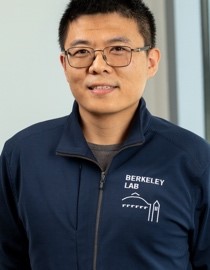
Biography: Yang Liu is a staff scientist in the Scalable Solvers Group of the Applied Mathematics and Computational Research Division at the Lawrence Berkeley National Laboratory, in Berkeley, California. Dr. Liu received the Ph.D. degree in electrical engineering from the University of Michigan in 2015. From 2015 to 2017, he worked as a postdoctoral fellow at the Radiation Laboratory, University of Michigan. From 2017 to 2019, he worked as a postdoctoral fellow at the Lawrence Berkeley National Laboratory. His main research interest is in numerical linear and multi-linear algebras, computational electromagnetics and plasma, scalable machine learning algorithms, and high performance scientific computing. Dr. Liu is the lead developer of the linear solver package ButterflyPACK and autotuning package GPTune, and is a core developer for linear solver packages SuperLU_DIST and STRUMPACK. Dr. Liu is the recipient and co-recipient of the ACES Early Career Award 2025, PDSEC Best Paper Award 2025, AT-AP RASC Young Scientists Award 2022, the APS Sergei A. Schelkunoff Transactions Prize 2018, FEM first place student paper award, 2014, and the ACES second place student paper award, 2012.
-
03/12/26
Dr. Vishal Patil - UCSD
Topological Dynamics of Knots and Tangles
AbstractTopology and geometry play fundamental roles in controlling the dynamics of biological and physical systems, from chromosomal DNA and biofilms to cilia carpets and worm collectives. How topological rules give rise to adaptive, self-optimizing dynamics in soft and living matter remains poorly understood. Here we investigate the interplay between topology, geometry and mechanics in knotted and tangled matter. We first examine the adaptive topological dynamics exhibited by California blackworms, which form disordered living tangles in minutes but can rapidly untangle in milliseconds. By combining link-based tangling metrics with stochastic trajectory equations, we explain how the dynamics of individual active filaments controls their emergent topological state. Building on this framework, we then investigate tangled structures with local alignment. We demonstrate how the algebra of braids governs the mechanics and stability of braided filamentous networks in a range of biological systems. By identifying how topology and adaptivity produce stable yet responsive structures, these results have applications in understanding broad classes of adaptive living systems.
-
03/12/26
Scott Sheffield - MIT
Yang-Mills and the surprising implications of 1+1=2 and 2+2=4
AbstractIn 2000, the Clay Institute offered one million dollars for a mathematical construction of 4D Yang-Mills gauge theory. That problem remains unsolved, but there has been spectacular progress in recent years on many related 2D and 4D problems.
It all starts with 1+1=2. The fact that 1+1=2 implies that two non-parallel lines in the plane (co-dimension 1) meet at a point (co-dimension 2). Less trivially, any two paths through a square (one top to bottom, one left to right) intersect somewhere. Similarly, 2+2=4 implies that two fully-non-parallel 2D planes in 4D meet at a point (interpret one dimension as time and imagine moving lines in 3D colliding like light sabers) and that knotted loops in 3D cannot be disentangled without tearing rope.
Further implications include the self-duality of 1-forms (in 2D) and 2-forms (in 4D), the conformal invariance of special Gaussian fields in 2D and 4D, and the self-duality of cellular spanning trees, along with other fundamental results about random curves and surfaces, spin systems and connections. How will this help with our remaining open problems?
-
03/13/26
Dr. Nathan Chen - Harvard University
Characterizing algebraic varieties through symmetries
AbstractThe goal of this talk is to explore what symmetries can say about an object. We will then focus on the case of algebraic varieties, where the symmetries are birational self-maps. This is joint work with L. Esser, A. Regeta, C. Urech, and I. van Santen.
-
03/17/26
Prof. Achill Schürmann - University of Rostock, Germany
Computing Certificates for Complete Positivity
AbstractA key problem in computer proofs based on solutions from copositive optimization, is checking whether or not a given quadratic form is completely positive or not. In this talk we describe the first known algorithm for arbitrary rational input. It is based on a suitable adaption of Voronoi's Algorithm and the underlying theory from positive definite to copositive quadratic forms. We observe several similarities with the classical theory, but also some differences, in particular for three and more variables. A key element and currently the main bottleneck in our algorithm is an adapted shortest vector computation, asking for all nonnegative integer vectors attaining the copositive minimum of a given copositive quadratic form. (This is based on joint work with Valentin Dannenberg, Alexander Oertel, Mathieu Dutour Sikiric and Frank Vallentin).
-
03/19/26
Sutanay Bhattacharya
Coinvariants in Superspace
AbstractThe rank $n$ superspace $\Omega_n$ is the algebra of polynomial-valued differential forms on affine $n$-space. This carries an $G$-action for any pseudo-reflection group $G$ -- two important examples being the symmetric group $\mathfrak S_n$ and the hyperoctahedral group $\mathfrak B_n$. The superspace coinvariant ring for $G$, defined as the quotient of $\Omega_n$ cut out by $G$-invariants of $\Omega_n$ with vanishing constant term, has received increased attention in recent years. In this talk, we explore some recent results on the superspace coinvariant rings for $\mathfrak S_n$ and $\mathfrak B_n$, including their Hilbert series, explicit monomial bases, and their representation-theoretic structures.
-
03/30/26
Robert Koirala - UCSD
Structure Theory of Parabolic Nodal and Singular Sets
AbstractWe will discuss new estimates for the size and structure of the nodal set $\{u=0\}$ and the singular set $\{u=|\nabla u|=0\}$ of solutions to parabolic inequalities with parabolic Lipschitz coefficients. In particular, we show that almost all of these sets are covered by regular parabolic Lipschitz graphs, with quantitative control, and that both satisfy parabolic Minkowski bounds depending only on a doubling quantity at a point. Many of these results are new even in the case of the heat equation on $\mathbb{R}^n \times \mathbb{R}$. This is joint work with Max Hallgren and Zilu Ma.
Apr
-
04/01/26
Wei Yao - U. Chicago
$p$-adic height pairing using $K_2$-class field theory and Galois-valued heights
AbstractIn this talk, I will construct a $p$-adic height pairing for curves with split degenerate stable reduction over a prime $p$ using the higher class field theory of Kato-Saito. This pairing can be shown to coincide with the standard Coleman-Gross height pairing when extended to the semistable reduction case using methods by Besser and Vologodsky. At the end, I will briefly mention how this new method inspires the definition of a height pairing valued in certain Galois groups related to the function field of the original curve.
[pre-talk at 3pm]
-
04/02/26
Professor Tarek Elgindi - Duke University
Aspects of Steady Solutions to the Euler Equation
AbstractI will discuss various problems related to the study of the incompressible Euler equation. The main questions that we will look at have to do with the construction and classification of steady solutions, their stability properties, and the dynamics of nearby unsteady solutions.
-
04/03/26
Professor Pak-Yeung Chan - National Tsing Hua University
Flying wing construction of steady Ricci solitons
AbstractRicci solitons are generalizations of the Einstein manifolds and are self similar solutions to the Ricci flow. In particular, steady Ricci solitons are eternal solutions to the Ricci flow. In this talk, we will discuss the flying wing construction of some Kahler and Riemannian steady Ricci solitons of nonnegative curvature. This is based on joint work with Ronan Conlon and Yi Lai, as well as with Yi Lai and Man Chun Lee.
-
04/03/26
Dr. James McKernan - UC San Diego
Forgetful functors
AbstractWe review some recent results on the problem of reconstructing a variety from its topology. This includes some recent work with Fanjun Meng and Lingyao Xie.
-
04/06/26
Dr. Ilia Nekrasov - University of California, Berkeley
Where to look for tensor categories?
AbstractI will review recent constructions of oligomorphic tensor categories generalizing Deligne's Rep(S_t). Then, I will lean into the model theoretic part of the question. Specifically, I will explain where there are no continuous families like the original Rep(S_t) and where you should look for n-parameter families, i.e., depending on n free variables. Ultimately, these questions are closely related to classes of structures in model theory.
-
04/07/26
Mikael de la Salle - University of Lyon
Kakeya conjecture and High Rank Lattice von Neumann algebras
AbstractMy talk will be about two open questions and a (perhaps surprising) link between them:
(1) Connes' rigidity conjecture, that in particular predicts that the von Neumann algebras of PSL_n(Z) are not isomorphic for different values of n. Ancient works with Vincent Lafforgue and Tim de Laat suggest a possible approach to it: does the non-commutative Lp space of the von Neumann of SL(n,Z) have the completely bounded approximation property for some non-trivial p?
(2) Kakeya conjecture : every subset of R^d containing a unit segment in every direction has dimension d.Both questions are open for large values of the parameters (n>2 and >3). I will explain why (1) is difficult: it implies some form of (2) for d<=(n+1)/2.
-
04/07/26
Mark Levi - Penn State University
Counterintuitive Effects in Mechanics
AbstractThe magical ability of a spinning top to stay upright fascinated people for many thousands of years and in many civilizations. Clay spinning tops dated to about 6,000 years ago were excavated in Iraq. And for all these millenia another similarly counterintuitive phenomenon went undiscovered until 1908, when Stephenson observed that an upside-down pendulum becomes stable if its pivot is subjected to vertical vibrations (there is no feedback involved). Later other counterintuitive effects were discovered – and used in physical experiments. Traditionally, this subject has been treated by formal computations, sometimes quite long. This is an effective practical tool, but it does not explain what is really going on. As an alternative to this approach, I will give a geometrical explanation of the seemingly mysterious effect in which an inverted multiple pendulum stands upright when its pivot undergoes vertical vibrations. I will also describe the recently discovered “ponderomotive Lorentz force”: a point mass in a rapidly oscillating potential force field behaves as if it were electrically charged and in the presence of magnetic field. This is a purely mathematical effect: there is no electricity or magnetism involved; superficially this looks like the Faraday effect in which a changing electric field generates a magnetic field.
-
04/08/26
Yat-Tin Chow - UC Riverside
An inverse problem in mean field game from partial boundary measurement
AbstractIn this work, we consider an inverse problem in mean-field games (MFG). We aim to recover the MFG model parameters that govern the underlying interactions among the population based on a limited set of noisy partial observations of the population dynamics under the limited aperture. Due to its severe ill-posedness, obtaining a good quality reconstruction is very difficult. Nonetheless, it is vital to recover the model parameters stably and efficiently in order to uncover the underlying causes for population dynamics for practical needs.
Our work focuses on the simultaneous recovery of running cost and interaction energy in the MFG equations from a finite number of boundary measurements of population profile and boundary movement. To achieve this goal, we formalize the inverse problem as a constrained optimization problem of a least squares residual functional under suitable norms with L1 regularization. We then develop a fast and robust operator splitting algorithm to solve the optimization using techniques including harmonic extensions, three-operator splitting scheme, and primal-dual hybrid gradient method. Numerical experiments illustrate the effectiveness and robustness of the algorithm.
This is a joint work with Samy W. Fung (Colorado School of Mines), Siting Liu (UCR), Levon Nurbekyan (Emory University), and Stanley J. Osher (UCLA).
-
04/14/26
Otte Heinävaara - Caltech
Convolution comparison measures
AbstractFree convolution is a fundamental operation in free probability. It expresses the distribution of the sum of two freely independent random variables in terms of the distributions of the summands. Compared to classical convolution of probability measures, free convolution is considerably more difficult to analyze and calculate. To untangle this complicated operation, we introduce a precise functional comparison between free and classical convolutions. This comparison states that the expectation of f w.r.t. classical convolution is larger than the expectation w.r.t. free convolution as long as f has non-negative fourth derivative. The comparison is based on the existence of convolution comparison measures, novel measures on the plane whose positivity depends on a peculiar identity involving Hermitian matrices.
-
04/14/26
Brendon Rhoades - UCSD
A q-analog of Ehrhart theory
AbstractClassical Ehrhart theory studies lattice point enumeration in integer dilates of lattice polytopes. We discuss a new and conjecture-laden q-analog of Ehrhart theory involving the orbit harmonics deformation of algebraic combinatorics. A new and somewhat subtle `harmonic algebra' attached to a lattice polytope plays a key role. Joint with Vic Reiner.
-
04/15/26
Nathan Conlon - UC San Diego
Towards expansion in SL_n(F_p[[t]])
-
04/16/26
Dr. Florian Kogelbauer - ETH Zürich
Hydrodynamic Manifolds for Kinetic Equations
AbstractWe discuss recent developments around Hilbert's sixth problem about the passage from kinetic models to macroscopic fluid equations. We employ the technique of slow spectral closure to rigorously establish the existence of hydrodynamic manifolds and derive new non-local fluid equations for rarefied flows independent of Knudsen number. We show the singularity of certain scaled solutions, including the divergence of the Chapman--Enskog series for an explicit example, and apply neural nets to learn the optimal hydrodynamic closure from data. The new dynamically optimal constitutive laws are applied to a rarefied flow problem and we discuss the classical problem of the number of macroscopic rarefied fluid fields from a data-driven point of view.
Bio: Florian Kogelbauer is a Senior Research Fellow at ETH Zürich’s Department of Mathematics, affiliated with RiskLab and the Finsure Tech Hub. His research centres on nonlinear dynamical systems, kinetic theory, and fluid dynamics, with recent work on hydrodynamic closures and spectral theory for kinetic equations. He previously held academic and research roles at the University of Vienna and AIST-Tohoku University in Japan, alongside consulting positions at KPMG Austria.
-
04/16/26
Dr. Lihan Wang - California State University Long Beach
What Can We Hear About the Boundary?
AbstractIn 1966, Mark Kac asked the famous question “Can one hear the shape of a drum?” In his article with this question as the title, he translated it into eigenvalue problems for planar domains. This question highlighted the relationship between eigenvalues and geometry. One can then ask how eigenvalues are related to the geometry of the boundary.
In this talk, we consider a special type of eigenvalues, called Steklov eigenvalues, that are closely tied to boundary geometry. We will introduce Steklov eigenvalues and explain their basic background and applications. Then we will discuss our recent results on inequalities relating Steklov eigenvalues to the boundary area of compact manifolds. -
04/21/26
Yuchao Yi - UCSD
Inverse Problems for Hyperbolic PDEs and Lorentzian Manifolds
-
04/21/26
Ethan Partida - Brown University
Graded Ehrhart theory of unimodular zonotopes
AbstractGraded Ehrhart theory is a new q-analogue of Ehrhart theory introduced by Reiner and Rhoades. Roughly, it is the study of how a canonical, graded lattice point count of a polytope behaves under dilations. The grading in this count is constructed via the orbit harmonics method. In this talk, I will discuss the graded Ehrhart theory of unimodular zonotopes and its connections to matroid theory. In particular, I will explain why graded lattice point counts of unimodular zonotopes are q-integer evaluations of Tutte polynomials and how arrangement Schubert varieties can be used to study the harmonic algebras of unimodular zonotopes. This talk is based on joint work with Colin Crowley.
-
04/23/26
Haixiao Wang - University of Wisconsin
Spectral Embeddings via Random Geometric Graphs for Noisy, High-Dimensional, and Nonlinear Datasets with Applications
AbstractClustering is one of the fundamental problems in statistics and machine learning. Classical generative models such as the Stochastic Block Model (SBM) and Gaussian Mixture Model (GMM) are widely used for synthetic data generation and theoretical evaluation, but much of the literature assumes linearly separable clusters---an assumption that can fail in the presence of nonlinear geometry. We study a nonlinear multi-manifold model in which disjoint manifolds represent different clusters and the observations are corrupted by high-dimensional noise. We propose a kernel-based spectral embedding algorithm, based on the Random Geometric Graph (RGG) constructed from the data. Following the framework established by Ding and Ma (2023), we show that the embedding converges to its noiseless counterpart when the signal-to-noise ratio is sufficiently large. For downstream tasks, the embedding can be used for community detection problems. When different manifolds are sufficiently separated, the procedure recovers the community structure with vanishing error. Based on joint work with Xiucai Ding.
-
04/23/26
Shangjie Zhang
Computations in equivariant stable homotopy theory
AbstractThis dissertation consists of four papers that develop computational and structural results in equivariant stable homotopy theory. The results include the computation of the reduced ring of the $RO(C_2)$-graded $C_2$-equivariant stable stems, the construction of the first family of $C_{p^n}$-equivariant ``$v_1$''-self maps, the computation of the $C_{p^n}$-equivariant Mahowald invariants of all elements in the Burnside ring, extending the classical computations of Bredon--Landweber and Iriye, and the computation of the spoke-graded $C_3$-equivariant stable stems.
-
04/24/26
Anil Kamber - UCSD
On the Loss-Landscape Geometry of Deep Matrix Factorization
AbstractUnderstanding the loss-landscape geometry near a minimum is key to explaining the implicit bias of gradient-based methods in non-convex optimization problems such as deep neural network training and deep matrix factorization. A central quantity to characterize this geometry is the maximum eigenvalue of the Hessian of the loss. Its precise role has been obfuscated because no exact expressions for this sharpness measure are known in general settings. In this talk, I will present an analysis to derive a closed-form expression for the maximum eigenvalue of the Hessian matrix of an overparameterized deep matrix factorization problem with squared-error loss. I will show that this expression reveals fundamental properties of the loss landscape in deep matrix factorization. For instance, flat minima correspond to spectral-norm balanced minima in depth-2 matrix factorization. Furthermore, I will discuss the implications of this analysis. Beyond this, I will further discuss how l2 regularization reshapes the loss landscape and the set of minimizers of the overparameterized deep matrix factorization problem.
-
04/28/26
Changying Ding - UCLA
Structure and non-isomorphisms of q-Araki-Woods factors, Part II
AbstractThis is a continuation of Hui Tan's talk on joint work studying the structure and classification of q-Araki-Woods factors. I will focus on the proofs of the main results: the dichotomy for subalgebras in continuous cores underlying strong solidity, and the failure of biexactness for q-Araki-Woods factors with infinite-dimensional representations via norm estimates from Nou and Hiai.
-
04/28/26
Hai Zhu - UCSD
Rook placements, orbit harmonics, and shadow play
AbstractLet $\mathrm{Mat}_{n\times m}(\mathbb{C})$ be the affine space of $n\times m$ complex matrices, and let $\mathcal{Z}_{n,m,r}$ (resp. $\mathcal{UZ}_{n,m,r}$) be the locus in $\mathrm{Mat}_{n\times m}(\mathbb{C})$ corresponding to rook placements with exactly (resp. at least) $r$ rooks. The orbit harmonics method yields two quotient rings $R(\mathcal{Z}_{n,m,r})$ and $R(\mathcal{UZ}_{n,m,r})$, where both rings have the additional structures of $\mathfrak{S}_n\times\mathfrak{S}_m$-modules. We find the generators of their defining ideals and compute their graded Frobenius image. Furthermore, we give a nontrivial generalization of Viennot's shadow line avatar of the Schensted correspondence to rook placements in $\mathcal{UZ}_{n,m,r}$. This generalization is used to determine the standard monomial basis of $R(\mathcal{UZ}_{n,m,r})$ with respect to a diagonal term order. Joint with Jasper (Moxuan) Liu.
-
04/29/26
Dietmar Bisch - Vanderbilt University
New Quantum Symmetries from Subfactors
AbstractVaughan Jones introduced an index for inclusions of certain von Neumann algebra in the 1980's and proved that it is surpisingly rigid. This rigidity is due to a rich combinatorial structure that is inherent to the representation theory of a subfactor with finite index. Subfactor representations reveal interesting unitary tensor categories, or quantum symmetries, whose algebras of intertwiners always contain the Temperley-Lieb algebras and, if an intermediate subfactor is present, the Fuss-Catalan algebras of Jones and myself. The case of two intermediate subfactors is much more involved and not much progress had been made since the late 1990's.
I will discuss recent work with Junhwi Lim in which we determine the quantum symmetries of a subfactor when two intermediate subfactors occur, and the four algebras form a cocommuting square. These new symmetries turn out to be related to partition algebras and Bell numbers.
-
04/30/26
Chris Gartland - UNC Charlotte
$L^1$ Actions and Embeddings of Property A Spaces
AbstractThe Wasserstein metric over a metric space X is an optimal-transport based distance on the set of probability measures on X. Metric spaces for which the optimal transport problem is "easiest" to solve are trees, in the sense that the Wasserstein metric on trees isometrically embeds into $L^1$. Property A is a coarse invariant of metric spaces introduced by Yu as an approach to solving the coarse Baum-Connes conjecture. We prove a new characterization of bounded degree graphs X with Property A as precisely those that are coarsely equivalent to another space Y whose Wasserstein metric admits a biLipschitz embedding into $L^1$. Applications to group actions on Banach spaces will be discussed. Based on joint work with Tianyi Zheng and Ignacio Vergara.
-
04/30/26
Professor Yanyan Li - Rutgers University
Harmonic Functions and Beyond
AbstractWe will first recall some basic results on harmonic functions: the mean value property, the maximum principle, the Liouville theorem, the Harnack inequality, the Bocher theorem, the capacity and removable singularities. We will then present a number of more recent results on some conformally invariant elliptic and degenerate elliptic equations arising from conformal geometry. These include results on Liouville theorems, Harnack inequalities, and Bocher theorems.
May
-
05/04/26
Prof. Alexander Kiselev - Duke University
Singularity suppression by fluid flow
AbstractTransport by fluid flow can provide one of the less understood regularization mechanisms in PDE. In this talk, I will focus on the 2D Keller-Segel equation for chemotaxis set on a general domain and coupled via buoyancy with the fluid obeying Darcy's law - a much studied model of the incompressible fluid flow in porous media. It is well known that solutions to the 2D Keller-Segel equation can form singularities in finite time if the mass of the initial data is larger than critical. It turns out that if the equation is coupled with fluid flow obeying Darcy's law via buoyancy, this completely regularizes the system, leading to globally regular solutions for arbitrarily large initial data. One of the key ingredients in the proof is a new generalized Nash inequality, which employs anisotropic norm that is natural in the context of the incompressible porous media flow. This talk is based on works joint with Kevin Hu, Naji Sarsam, and Yao Yao.
-
05/05/26
Alonso Delfin - CU Boulder
Twisted Crossed Products of Banach Algebras
AbstractThe main goal of this talk is to introduce twisted crossed products of Banach algebras by locally compact groups.
Classical crossed products of Banach algebras have been extensively studied for different classes of representations, including contractive representations on L^p-spaces. In this talk, we will give a general formulation for Banach algebras associated with twisted dynamical systems. Recent developments in L^p-twisted crossed products have mostly focused on situations where either the algebra is the complex numbers or when the group is discrete (more generally for étale groupoids). We present a universal characterization of the twisted crossed product when the acting group is locally compact and the Banach algebra has a contractive approximate identity.
As an application, we focus on the case when the representations are contractive ones acting on L^p spaces. We briefly discuss a reduced version for L^p-operator algebras and present conjectures regarding amenability and rigidity when p\neq 2. Time permitting, we will present a generalization of the so called Packer–Raeburn trick to the L^p-setting, by showing that the universal L^p twisted crossed product is ``stably'' isometrically isomorphic to an untwisted one.
This is joint work with Carla Farsi and Judith Packer.
-
05/05/26
Charlie Chen - University of California, San Diego
Parallelizing Quantum Cascade Circuits
AbstractTBD
-
05/05/26
Prof. Robin Neumayer - CMU
Rigidity of critical points of hydrophobic capillary functionals
AbstractThe capillary energy functional models the equilibrium shape of a liquid drop meeting a substrate at a prescribed interior contact angle. We will discuss a rigidity theorem for volume-preserving critical points of the capillary energy in the half-space: among all sets of finite perimeter, every such critical configuration corresponding to a prescribed contact angle between 90 degrees and 120 degrees must be a finite union of spheres and spherical caps with the correct contact angle. Assuming that the tangential part of the capillary boundary is $\mathcal{H}^n$-null, this rigidity extends to the full hydrophobic range of contact angles between 90 degrees and 180 degrees. We will also present an anisotropic counterpart, establishing rigidity under suitable lower density assumptions. This talk is based on joint work with A. De Rosa and R. Resende.
-
05/06/26
Maya Chang - University of California, San Diego
Conjecture of Gross - Fourier Coefficients on $G_2$ and Cubic Twist L-Values Part I
AbstractBenedict Gross has a conjecture relating the square roots of the central values of a certain L-function of a cuspidal eigenform $f$ to the Fourier coefficients of the lift of $f$ to the group $G_2$. We describe our methods to compute the central values of the L-function of $f$, twisted by a Dirichlet character associated to a Galois cubic field. We will provide evidence for this conjecture of Gross via comparison with Fourier coefficients on $G_2$ computed by Aaron Pollack. This is joint work with Michael Hoffman.
-
05/06/26
Michael Hoffman - University of California, San Diego
Conjecture of Gross - Fourier Coefficients on $G_2$ and Cubic Twist L-Values Part II
AbstractBenedict Gross has a conjecture relating the square roots of the central values of a certain L-function of a cuspidal eigenform $f$ to the Fourier coefficients of the lift of $f$ to the group $G_2$. We describe methods to compute the central values of the L-function of $f$, twisted by a Dirichlet character associated to a Galois cubic field. We will provide evidence for this conjecture of Gross via comparison with Fourier coefficients on $G_2$ computed by Aaron Pollack. This is joint work with Maya Chang.
-
05/06/26
-
05/06/26
Allyson Ybarra - University of California, San Diego
Hypergraph Data Analysis with Applications to Ecological Relationships
-
05/06/26
Everett Howe
Curves of genus 2 with maps of every degree to a fixed elliptic curve
AbstractWe show that up to isomorphism there are exactly twenty pairs $(C, E)$, where $C$ is a genus-2 curve over the complex numbers, where $E$ is an elliptic curve over the complex numbers, and where for every integer $n > 1$ there is a map of degree $n$ from $C$ to $E$. For example, if $C$ is the curve $y^2 = x^5 + 5 x^3 + 5 x$, and if $E$ is an elliptic curve with CM by the order of discriminant -20, then $(C, E)$ is such a pair.
On the other hand, we produce some finite sets $S$ of integers such that if $C$ is a genus-2 curve in characteristic 0, and if for every $n$ in $S$ there is an elliptic curve $E_n$ and a degree-$n$ map $\phi_n$ from $C$ to $E_n$, then for at least one of these $n$, the map $\phi_n$ factors through a nontrivial isogeny.
[pre-talk at 3:00PM]
-
05/07/26
Professor Behrang Forghani - College of Charleston
Non-stability of Liouville measures under convex combinations
AbstractLet \mu be a probability measure on a group. A function satisfying the mean-value property with respect to \mu is called \mu-harmonic. The space of bounded harmonic functions plays a central role in understanding both the algebraic and geometric properties of groups, as well as the long-term behavior of the associated random walk. A measure \mu is called Liouville if every bounded mu-harmonic function is constant (equivalently, if the Poisson boundary is trivial). In this talk, I will show that the set of non-degenerate Liouville measures on a countable amenable group with the infinite conjugacy class property is not closed under convex combinations. This talk is based on joint work with Joshua Frisch from the University of California in San Diego.
-
05/07/26
Dr. Song-Ying Li - University of California, Irvine
Weak Decomposition of Hardy Spaces
AbstractIn this talk, I will present a joint work with W. Yang and C. Yuan on the weak decomposition of the Hardy and boundedness of the small Hankel operator on the Hardy space. It is well known that a function $f\in H^p(D)$, the Hardy space over the unit disc $D$ can be written as the product of functions $f_1$ and $ f_2 $ in $H^{2p}(D)$ with $\|f\|_{H^p}=\|f_1|_{2p} \|f_2\|_{H^2}$. This is no longer true for the Hardy space on the unit ball $B_n$ in ${\bf C}^n$ when $n>1$. A well known theorem was proved by Coiffman, Rochberg and Weiss (Ann. of Math., 1976) that there is a weak decomposition for $H^1(B^n)$ through atomic decomposition. Their theorem has been proved true for $H^p$ when $p\le 1$. In this talk,I will show that it remains true when $p>1$. As a consequence, we obtained boundedness of the small Hankel operator on Hardy spaces.
-
05/07/26
David Stephens - University of California, San Diego
A Simplified Proof of the Erdős Sumset Conjecture
AbstractIn this talk, we will discuss an ergodic proof of the Sumset Conjecture of Erdős, which asks if every set $A \subseteq \mathbb{N}$ with positive density contains $B + C$ for some $B,C \subseteq \mathbb{N}$ infinite. This result was originally proved by Moreira, Richter, and Robertson in 2019 using ultrafilters, however in this proof we will adapt the method of progressive measures recently developed by Kra, Moreira, Richter, and Robertson. We closely follow their proof, simplifying what we can along the way.
-
05/07/26
Richard Li - University of California, San Diego
An Embedding of the Commutator Subgroup into the Automorphism Group of the Full Shift
AbstractLet $A$ be a finite alphabet. The automorphism group $\mathrm{Aut}(A^\mathbb{Z})$ is the group of invertible sliding block codes from the full $A$-shift to itself. Suppose $N\trianglelefteq\mathrm{Aut}(
A^\mathbb{Z})$. By emulating methods from Kim and Roush's embedding, we show that either $N\le\mathbb{Z}$ or the commutator subgroup $[\mathrm{Aut}(2^\mathbb{Z}),\ mathrm{Aut}(2^\mathbb{Z})]$ embeds into $N$. It is known that the free group on $2$ generators embeds into this commutator subgroup. -
05/07/26
Yifan He - University of California, San Diego
Amenability and Almost Invariance
-
05/07/26
Professor Xiaojun Huang - Rutgers University - New Brunswick
Bergman Geometry of Domains in Complex Euclidean Spaces
AbstractIn one complex variable, a bounded domain in the complex plane carries two natural invariant Hermitian metrics: the Bergman metric and the canonical metric (a complete Hermitian metric with constant Gaussian curvature). When the domain has sufficiently smooth boundary so that the Bergman metric is complete, a consequence of a classical result of Qi-Keng Lu shows that these two metrics coincide if and only if the domain is the unit disk.
In higher dimensions, the Bergman metric can be defined analogously for bounded domains. However, the existence of a complete Kähler metric with constant holomorphic sectional curvature is generally too much to expect. Instead, Cheng–Yau and Mok–Yau proved the existence of a complete Kähler metric with constant Ricci curvature (the Kähler–Einstein metric) on such domains when they are pseudoconvex. The Bergman metric reflects the function theory and holomorphic geometry of the domain, while the Kähler–Einstein metric captures its pluripotential and complex geometric structure.
In this talk, I will discuss recent joint work with S. Y. Li (UC Irvine), M. Xiao (UCSD), and Hsiao (Taiwan)–Li (Wuhan), as well as related work by Ebenfelt–Treuner–Xiao and Savale–Xiao. We address longstanding questions concerning when the Bergman metric has constant holomorphic sectional curvature and when it is Einstein. -
05/08/26
Chase Wilson - UC San Diego
Advancement to Candidacy
-
05/08/26
Peter Eremeev - University of California, San Diego
Nonparametric Spectral Tests for Stationarity in Nonlinear Time Series
-
05/08/26
Linfeng Zang - University of California, San Diego
Almost Sure Hausdorff Dimension of d-dimensional Brownian Separable Permuton
AbstractTBD
-
05/08/26
Mr. Soham Ghosh - University of Washington
A Torelli theorem for the moduli of twisted vector bundles on curves
AbstractGiven a smooth projective curve C over an arbitrary field k, and a Brauer class $\alpha$ on C, one can construct the moduli space of $\alpha$-twisted vector bundles (of fixed rank and determinant) over C. I will discuss how given such a moduli space, one can recover the curve C and part of the Brauer class $\alpha$. Along the way, we give an explicit description of the moduli space of rank 2 twisted vector bundles with (fixed) odd determinant, on hyperelliptic curves, generalizing classical results of Desale-Ramanan. Consequently we obtain period-index bounds for certain Brauer classes on products of hyperelliptic curves, providing evidence towards a conjecture of Colliot-Thélène. Based on joint work (in progress) with Ting Gong, Max Lieblich and Arnab Roy.
-
05/08/26
Jingwen Gu - University of California, San Diego
Ladder-BAI: Online RLHF with Linear Dependence on Reward Scale
AbstractThis thesis studies a central theoretical challenge in online reinforcement learning from human feedback (RLHF): under Bradley--Terry preference feedback, comparing against a fixed weak reference can make learning exponentially inefficient in the reward scale because preference signals saturate. To isolate this issue, the thesis considers a simplified dueling-bandit setting and proposes Ladder-BAI, a self-updating baseline algorithm that repeatedly promotes the current best arm and identifies better arms through simple fixed-baseline comparisons. The main result shows that Ladder-BAI finds an $\epsilon$-optimal arm using $\tilde{O}(K R_{\max} + K/\epsilon^2)$ preference queries, achieving linear dependence on the reward scale $R_{\max}$. This improves substantially over prior exponential or higher-degree polynomial guarantees. The analysis is based on a reward-ladder argument: each epoch yields a constant reward improvement by keeping comparisons informative, and a final refinement step achieves $\epsilon$-accuracy. Synthetic experiments support the theory, confirming linear scaling in reward scale and number of arms, as well as the expected $1/\epsilon^2$ dependence on target accuracy.
-
05/11/26
Professor Peter Bartlett - UC Berkeley
Modern machine learning methods: large step-size optimization, implicit bias, and benign overfitting
AbstractThe impressive performance of modern machine learning methods seems to arise through different mechanisms from those of classical statistical learning theory, mathematical statistics, and optimization theory. Simple gradient methods find excellent solutions to non-convex optimization problems, and without any explicit effort to control model complexity they exhibit excellent prediction performance in practice. This talk will describe recent progress in statistical learning theory and optimization theory that demonstrates the optimization benefits of step-sizes that are too large to allow gradient methods to be viewed as an accurate time discretization of a gradient flow differential equation, that characterizes the solutions that are favored by gradient optimization methods, and that illustrates when those solutions can overfit training data but still provide good predictive accuracy.
-
05/11/26
Dr. Sam K. Miller - University of Georgia
Permutation twisted cohomology, remixed
AbstractRecently, Balmer—Gallauer deduced the tensor-triangular geometry of the so-called "derived category of permutation modules," which controls both the usual modular representation theory of a finite group as well as that of its "p-local" subgroups. Their construction of "permutation twisted cohomology" plays a key role in their deduction in the case of elementary abelian $p$-groups; here the authors deduce far stronger geometric results. In this talk, after reviewing some basics about tensor-triangular geometry and permutation modules, we'll describe how one can utilize endotrivial complexes, the invertible objects of this category, to extend Balmer—Gallauer's results for elementary abelian $p$-groups to all $p$-groups.
-
05/11/26
Professor Mikhail Belkin - UC San Diego
Geometry of data and representation of concepts in Large Language Models
-
05/12/26
Chris Xu
Algorithmic modular curve Chabauty-Coleman without equations
AbstractOn a modular curve of arbitrary congruence level, we introduce the notion of a "Makdisi symbol", a device that simultaneously gives a moduli-friendly coordinate system while also having an elegant Hecke theory. Concretely, these are cuspidal projections of products of two weight 1 Eisenstein series, and their study was originally pioneered by the work of Kamal Khuri-Makdisi. We show that a certain subclass of symbols, the "invertible Makdisi symbols", yield precisely the eigenforms of rank zero; combining this with the moduli interpretation, we obtain a systematic and relatively efficient algorithm to determine the rational points on a modular curve, so long as the curve has a rank zero eigenform. The algorithm is $p$-adic in nature, based on the method of Chabauty-Coleman, and does not require finding any equations for the curve.
-
05/12/26
Rishabh Dixit - UCSD
The Measure of Deception: An Analysis of Data Forging in Machine Unlearning
AbstractMotivated by privacy regulations and the need to mitigate the effects of harmful data, machine unlearning seeks to modify trained models so that they effectively ``forget'' designated data. A key challenge in verifying unlearning is forging—adversarially crafting data that mimics the gradient of a target point, thereby creating the appearance of unlearning without actually removing information. To capture this phenomenon, we consider the collection of data points whose gradients approximate a target gradient within tolerance $\epsilon$ ---which we call an $\epsilon$-forging set--- and develop a framework for its analysis. For linear regression and one-layer neural networks, we show that the Lebesgue measure of this set is small. It scales on the order of $\epsilon$, and when $\epsilon$ is small enough, $\epsilon^d$. More generally, under mild regularity assumptions, we prove that the forging set measure decays as $\epsilon^{(d-r)/2}$, where $d$ is the data dimension and $r < d$ is the dimension of vector space of right singular vectors corresponding to ``small" singular values of a variation matrix defined by the model gradients. Extensions to batch SGD and almost-everywhere smooth loss functions yield the same asymptotic scaling. In addition, we establish probability bounds showing that, under non-degenerate data distributions, the likelihood of randomly sampling a forging point is vanishingly small. These results provide evidence that adversarial forging is fundamentally limited and that false unlearning claims can, in principle, be detected.
-
05/12/26
Rufus Wilett - University of Hawai'i
The LLP, property FD, and representation stability
AbstractRepresentation stability asks whether an approximate representation of a group can be approximated by an actual representation. There are many technical variations of this basic question: I will focus mainly on approximate representations into finite-dimensional unitary groups.
I’ll introduce the two properties in the title - the LLP of Kirchberg and property FD of Lubotzky-Shalom - via group C*-algebras and explain how they imply some fairly weak representation stability results. I’ll then explain some refinements you can get using K-theory (without assuming any background knowledge of K-theory). Finally, I'll discuss the known range of validity of the LLP and property FD (I’ll also mention some related properties like Kechris’ property MD).
The non K-theoretic parts are based on joint work with Francesco Fournier-Facio.
-
05/12/26
Jennifer Balakrishnan - Boston University
Quadratic Chabauty in higher genus
AbstractDetermining rational points on modular curves is an important problem in arithmetic geometry; those curves which have Jacobian rank at least equal to the genus remain the frontier. While quadratic Chabauty can be an effective p-adic tool for computing rational points on certain modular curves where the rank of the Jacobian equals the genus, many of the underlying computations, such as computing a basis of de Rham cohomology, as well as the local height computations, become computationally prohibitive for higher genus non-split Cartan modular curves. We will discuss joint work in progress with Steffen Mueller and Jan Vonk to carry out quadratic Chabauty on the genus 8 non split Cartan modular curve $X_{ns}^+(19)$ and what remains to be done to complete the quadratic Chabauty computation.
-
05/12/26
Prof. Yannick Sire - JHU
Harmonic maps into singular spaces
AbstractThe heat flow of harmonic maps from a smooth, compact Riemannian manifold without boundary, (M,g) into another smooth, compact Riemannian manifold without boundary (N,h) was first studied in the seminal work of Eells and Sampson when the target manifold (N,h) has non-positive curvature. Gromov-Schoen studied harmonic maps from M into a singular Cat(0) space which was used to understand the p-adic superrigidity of lattices in groups of rank one. A key analytical property of such harmonic maps is the Lipschitz continuity, from which one derives Bochner type estimates and vanishing theorems. As for Eells-Sampson theorem, it is rather natural to study the associated gradient flow, and it has been a long open problem to construct suitable weak solutions in the singular setting. In this talk, I shall describe an elliptic approach (which goes back to De Giorgi and also T. Ilmanen in the 1990s) to this problem both in the smooth and the singular settings, i.e. when the target is CAT(0) space. I will explain how to get Lipschitz bounds in the space variables (hence a suitable solution of the flow) and how this new approach offers as well a new viewpoint on the old problem of mappings between smooth manifolds. This is joint work with FH Lin, A Segatti and C Wang.
-
05/13/26
Dr. Pallav Goyal - UC Riverside
Representation theory of the mirabolic quantum group
AbstractIn a classic paper from 1990, Beilison, Lusztig and MacPherson gave a geometric realization of the quantized enveloping algebra of gl_n by defining a convolution product on the space of invariant functions over the variety of pairs of n-step partial flags over a finite field. This construction was generalized by Rosso to the mirabolic setting by modifying the points on the variety to include the additional data of a vector. A presentation for this "mirabolic quantum group" in terms of generators and relations was recently given by Fan, Zhang and Ma. I will describe this construction of the mirabolic quantum group and discuss its representation theory. Time permitting, I will also discuss a mirabolic quantum Schur-Weyl duality that this algebra satisfies with a mirabolic version of the Hecke algebra of Type A.
-
05/15/26
Nicholas Karris - UC San Diego
Applications of Linearized Optimal Transport to Curves on the Wassertein Manifold
-
05/15/26
Sawyer Jack Robertson - UC San Diego
Optimal Transport on Graphs and Effective Resistance
AbstractThis Ph.D. thesis concerns optimal transport and effective resistance on finite weighted graphs. We investigate a number of directions, including applications of these topics to geometric graph theory and combinatorial optimization, as well as extensions of them to graphs with matrix-valued edge weights. We conclude with a number of results elucidating their connections.
-
05/15/26
Dr. Iacopo Brivio - Harvard University
Non-Extendable MMPs
AbstractIt was observed by Kollár that the moduli functor of stable varieties in characteristic p>0 is no longer proper when one considers varieties of dimension ≥ 3. The key point is the existence of families of plt good minimal models of general type for which taking the relative canonical model does not commute with base change. I am going to illustrate an example showing that this kind of pathological behavior is not limited to the relative canonical model, but can indeed occur for any step of the relative MMP.
-
05/19/26
Dr. Asuman Aksoy - Claremont McKenna College
From Classical Approximation to Banach Space Geometry: The Evolution of Bernstein’s Lethargy Theorem
AbstractWhile Weierstrass’ Approximation Theorem guarantees that continuous functions can be uniformly approximated by polynomials, it provides no information about the rate of this convergence. Bernstein’s Lethargy Theorem (BLT) classically addresses this gap by proving that the error of best polynomial approximation can decay at an arbitrarily slow, prescribed rate. This talk explores the evolution of BLT from its roots in classical approximation theory to its broad applications in functional analysis. We will discuss extensions of BLT to abstract Banach spaces and Frechet spaces. Building on this framework, we will investigate the deep connections between lethargy phenomena and operator ideals, the influence of Banach space reflexivity on the existence of lethargic convergence, and the interplay between BLT and interpolation theory via the Peetre K-functional.
-
05/19/26
Prof. James M. Scott - Auburn University
Nonlocal Models: Theory and Applications
AbstractAcross various applications, such as diffusion modeling, image processing, and mechanics, continuum models that incorporate nonlocal effects have seen greatly increased use in recent years. These models are characterized by partial integro-differential equations; that is, equations of integral operators that act on difference quotients of multi-variable functions. In this talk, we will discuss recent contributions to the mathematically rigorous underpinning of such nonlocal models across several different contexts. Such contributions include the properties of solutions to nonlocal equations, the robust nature of their discretizations, rigorous characterizations of long-range and other phenomena captured by the equations, and the consistency of nonlocal models with existing classical models in suitable asymptotic regimes. The contexts include continuum mechanics, semi-supervised learning, fractional PDEs, and coupled local-nonlocal equations.
-
05/19/26
Christopher Xue - UC San Diego
Hochschild cohomology of $p$-adic Lie groups
-
05/19/26
Johnny Jingze Li - UC San Diego
A Calculus of Emergence: Nonlinearity, Hierarchy, and Neural Computation
-
05/20/26
Brandon Alberts - Eastern Michigan U.
Number Field Counting via Multiple Dirichlet Series
AbstractI will show how to use multiple Dirichlet series techniques to prove new asymptotics for the number of G-extensions with bounded discriminant, inspired by their use in the study of moments of $L$-functions. In particular, assuming the generalized Lindelof Hypothesis we prove the existence of an asymptotic whenever $G$ has nilpotency class $2$. This work is joint with Alina Bucur.
[pre-talk at 3:00PM by Justine Dell]
-
05/20/26
Prof. Tingting Tang - San Diego State University
When algebra meets gradient descent: certifying the loss landscape of neural networks through algebraic geometry
AbstractA central mystery in deep learning is why gradient-based optimizers reliably find good solutions despite training a nonconvex loss function. Most theoretical work either proves favorable properties under strong assumptions or gives worst-case bounds that are too loose to be useful in practice. In this talk, I take a different approach: rather than analyzing large networks asymptotically, I study the loss landscape of a small, concretely specified network where every critical point can be computed exactly using tools from algebraic geometry. The findings are sharp: across all data realizations and all three optimizers, the dynamically accessible critical points are in exact bijection with the local minima of the loss, as independently confirmed by Hessian eigenvalue analysis. All saddle points are completely inaccessible, with empirical basin measure zero. I also show that removing the network's scaling symmetry via an affine chart systematically degrades all three optimizers, a phenomenon explained by the fiber connectivity structure of the parameterization map. Finally, I will discuss how these findings position algebraically-certified small networks as a rigorous testbed for optimizer theory, and outline extensions to wider architectures and polynomial activation functions.
-
05/21/26
Mike Cranston - UCI
The Riemann zeta Process and Precise Large Deviations
AbstractOne can use the Riemann zeta function evaluated at a parameter s>1 to create a probability distribution on the positive integers. If X(s) is a random integer with this distribution, one might ask whether one can produce a natural stochastic process in the parameter s. Using an idea of Lloyd this is possible and reveals a predominant Poisson behavior in X(s). In addition, we can use mod-Poisson convergence of Jacod, Kowalski and Nikeghbali to prove precise large deviation estimates for the number of prime divisors of X(s) as s goes down to 1. These ideas apply more generally to integers selected via Dirichlet series, polynomials with coefficients in a finite field or ideals selected in a Dedekind domain. This talk is based on joint work with Jingyuan Chen and Mariia Khodiakova.
-
05/21/26
Sarah Kumar - UC San Diego
Advancement to Candidacy
-
05/21/26
Srivatsav Kunnawalkam Elayavalli - UMD
Strongly converging finite unitary representations: amalgamated free products, hyperbolic 3-manifold groups, extensions by exact groups, Bernoulli shifts.
AbstractI will present a series of new developments in the subject of strong convergence, development in joint works: with David Gao, Aareyan Manzoor, Gregory Patchell on a new source of purely finite matricial fields; with David Gao on Toeplitz exactness; and with David Gao and Mahan Mj on strongly converging unitary representations of extensions by exact groups. These works feature a new systematic method for proving strong convergence of unitary representations, and answers various open problems in the field. As an example, we show that for any closed hyperbolic 3-manifold, there exists a sequence of unitary representations with finite images strongly converging to the left regular representation. In light of Antoine Song's approach towards Yau's conjecture on the existence of minimal surfaces of negative curvature in 3-spheres, our work can be accessed towards constructing minimal 3 dimensional submanifolds whose shape is hyperbolic 3-space, inside larger dimensional spheres.
-
05/21/26
Professor David Fisher - Rice University
Totally geodesic manifolds: symmetry, finiteness, arithmeticity
AbstractI will give a (biased) survey on the role and importance of totally geodesic submanifolds, particularly in negative curvature. The goal will be to start with some broad strokes motivation in terms of differential geometry and symmetry, to move through older work where totally geodesic manifolds play a key role as a tool and then reach recent work of my own with various coauthors where finiteness results were proven. This includes joint work with Bader, Elliott Smith, Filip, Lafont, Lowe, Miller, and Stover. Elliott Smith and Miller were both UCSD undergrads.
-
05/21/26
Arijit Chakraborty - University of California San Diego
Power-saving Error Terms In Counting Number Fields By Discriminants
AbstractOne of the central problems in arithmetic statistics is counting number field extensions of a fixed degree with a given Galois group, ordered by discriminant. In this talk, we focus on extensions with Galois group of the form C2 ≀ H over an arbitrary base field. We begin by discussing the historical development of results in counting such extensions, including the work of Jürgen Klüners, who established the main term in this setting. We then turn to the problem of obtaining explicit power-saving error terms. Using Tauberian methods, we describe how such savings can be achieved, and present an alternative approach that leads to improved power-saving error terms in greater generality. We conclude with a brief discussion of possible directions for future work.
-
05/22/26
Prof. Jicong Fan - The Chinese University of Hong Kong, Shenzhen
Comparing Graphs Using Matrix Factorization
AbstractGraphs are ubiquitous for modeling relational data, appearing across social networks, biology, and chemistry. Measuring the similarity between graphs is central to tasks like graph classification and clustering, yet it poses significant computational challenges on large datasets. We introduce a matrix factorization framework for graph comparison. Viewing adjacency matrices as kernel matrices, we first define a pseudo-metric called MMFD that admits a simple closed-form solution without iterative optimization. We then generalize it to MFD, which more effectively exploits the factor structure of adjacency matrices. To handle large-scale clustering, we further develop a variant with linear time and space complexity in the number of graphs. Experiments on real-world datasets show that our methods substantially improve clustering performance and efficiency over existing approaches.
-
05/22/26
Zehong Zhao - UC San Diego
Smooth representations in natural characteristics
-
05/22/26
David Gao - UC San Diego
Applications of Ultraproduct Methods in Operator Algebras
AbstractIn this talk, a selection of results from my thesis will be presented. The results will concern the application of ultraproduct methods in operator algebras and surrounding fields. They will be organized around three themes: applications to the structure theory of operator algebras, continuous model theory of tracial von Neumann algebras, and approximation theory of groups and group actions.
-
05/22/26
Shubhankar Sahai - UC San Diego
p-adic motives and Frobenius liftable schemes
AbstractRecent work of Bhatt-Lurie and Drinfeld has constructed a category of p-adic motives (aka prismatic F-gauges) for schemes in positive and mixed characteristic. Roughly, these correspond to a notion of 'variations of Hodge structures' in integral p-adic Hodge theory. In this talk, I will review this notion and explain how to completely describe it in the case of Frobenius liftable schemes in positive characteristic . This description is in terms of (big) Fontaine-Laffaile modules, a somewhat classical coefficients system in p-adic Hodge theory and is closely related to recent results of Ogus and Terentiuk--Vologodsky--Xu.
While the result is of a classical flavour, our techniques use some recent conceptual advances in derived geometry, due to various authors, which we will explain if time permits. -
05/26/26
Zhichen Zhao - UC San Diego
Advancement to Candidacy
-
05/26/26
Todd Kemp - UC San Diego
Bias and Division in the Free World
AbstractStatistical bias is an inevitable factor in most measurements. In many cases, bias transforms can be employed to counter the effect and produce (asymptotically) unbiased estimators. The most common such transform is the size bias. An infinitesimal version called zero bias was introduced by Goldstein and Reinert in 1997, and has become a powerful tool in Stein's method (for Gaussian and Poisson approximation).
In this talk, I will discuss recent work (arxiv.org/2403.19860) on free probability analogs of bias transforms. I will discuss existence and regularity of free zero bias, and somewhat surprising connections to the theory of (freely) infinitely divisible laws, giving a new proof of the free Levy--Khintchine formula in the process. I will also discuss connections between size bias and a new class: positively freely infinitely-divisible laws, and a new kind of free Levy--Khintchine formula.
Finally, time permitting, I will discuss our ongoing work developing Stein's method in free probability, using free zero bias to prove sharp quantitative free central limit theorems even for some systems with long range correlations.
This is joint work with Larry Goldstein.
-
05/26/26
Felipe Castellano-Macias - UC San Diego
Birational Geometry of Additive Varieties
-
05/26/26
Haotian Qu - UC San Diego
Critical Divisors for Minimal Exponents
AbstractThis defense explores the computation of the minimal exponent of a hypersurface singularity using birational geometry. Although the minimal exponent is originally defined through the Bernstein–Sato polynomial, we show that in several important cases it can be detected directly on a log resolution.
For isolated quasi-homogeneous singularities, we demonstrate that a single weighted blow-up produces an exceptional divisor that computes the minimal exponent. Building on this, we utilize the Mustață–Chen birational formula and Chen’s inversion of adjunction to formulate a squeeze criterion. Finally, we apply this criterion to ADE singularities and extend the results to certain Newton-degenerate cases, such as Cayley cubic singularities.
-
05/26/26
Professor Melvin Leok - UC San Diego
The Connections Between Discrete Geometric Mechanics, Information Geometry, Accelerated Optimization and Machine Learning
AbstractGeometric mechanics describes Lagrangian and Hamiltonian mechanics geometrically, and information geometry formulates statistical estimation, inference, and machine learning in terms of geometry. A divergence function is an asymmetric distance between two probability densities that induces differential geometric structures and yields efficient machine learning algorithms that minimize the duality gap. The connection between information geometry and geometric mechanics will yield a unified treatment of machine learning and structure-preserving discretizations. In particular, the divergence function of information geometry can be viewed as a discrete Lagrangian, which is a generating function of a symplectic map, that arise in discrete variational mechanics. This identification allows the methods of backward error analysis to be applied, and the symplectic map generated by a divergence function can be associated with the exact time-h flow map of a Hamiltonian system on the space of probability distributions. We will also discuss how time-adaptive Hamiltonian variational integrators can be used to discretize the Bregman Hamiltonian, whose flow generalizes the differential equation that describes the dynamics of the Nesterov accelerated gradient descent method.
-
05/27/26
Jiyoung Choi - UC San Diego
Global Optimization of Structured Problems
-
05/27/26
Shubham Saha - UC San Diego
Universal moduli stacks of bundles over curves
-
05/27/26
Jaehong Moon - UIUC
State-Dependent Lyapunov Framework for Rank-1 Matrix Factorization
AbstractIn this talk, I will discuss gradient descent for rank-1 matrix factorization at large step sizes. The main idea is to construct a parameterized quadratic certificate $I(\delta;\cdot)$ whose level sets shrink along the discrete-time dynamics, thereby producing a monotone state variable $\delta_t$. This state-dependent Lyapunov perspective gives a geometric mechanism for convergence in the certified regime and explains why, in the post-critical regime, trajectories are driven toward a balanced terminal manifold. I will also describe how these certificates can be derived from structural monotonicity axioms: in the scalar case, the certificate is uniquely determined, and the same local Lagrange-multiplier analysis constrains rank-1 extensions through their signal and noise blocks. Finally, I will present numerical evidence suggesting that the same certificate mechanism may extend beyond the proved settings, including two-dimensional rank-1 approximation and quartic perturbations of scalar factorization.
-
05/27/26
Nikolas Castro - UC San Diego
The Fargues-Scholze Correspondence over the Semisimple Generic Locus
AbstractThe moduli of semisimple generic L-parameters, introduced by Hansen, is a dense open substack of the moduli stack of L-parameters, and it is expected to be the largest open substack for which Fargues-Scholze’s categorical local Langlands correspondence can be understood reasonably explicitly. In this talk we show that much of the correspondence over this locus can indeed be made explicit, assuming certain properties of the correspondence such as geometric Eisenstein compatibility (currently known for GL(2)).
[pre-talk at 3:00PM]
-
05/28/26
-
05/28/26
Jordan Benson - UC San Diego
Tau-Torsion in the C-Motivic Adams Spectral Sequence
AbstractWe determine the $\tau^n$-torsion in the first 5 lines of the $E_2$ page of the $\mathbb{C}$-motivic Adams spectral sequence using the techniques of Burklund-Xu. In particular, every element in this range is either $\tau^1$-torsion or $\tau$-free. We also show that $\tau^n$-torsion elements can appear only in Adams filtration at least $2n+2$ and give further evidence of a possible $3n$ bound.
-
05/28/26
Yongyuan Huang - University of California, San Diego
Computing with Jacobians of Shimura curves: point counts and isogeny decomposition via trace formula and Censuses of low-genus curves over small finite fields
AbstractIn Part I, we provide an explicit version of the Eichler--Selberg trace formula for Shimura curves with level structure over the rationals. As an application, we provide an algorithm to compute the isogeny decomposition of the Jacobian of Shimura curves into modular abelian varieties using the method that Rouse--Sutherland--Zureick-
Brown developed for classical modular curves. We also give a trace formula for definite quaternionic modular forms over the rationals. In Part II, we compile a complete list of isomorphism class representatives of curves of genus 6 over $\mathbb{F}_2$. We use explicit descriptions of canonical curves in each stratum of the Brill--Noether stratification of the moduli space $\mathcal{M}_6$, due to Mukai in the generic case. Our computed value of $\#\mathcal{M}_6(\mathbb{F}_2)
$ agrees with the Lefschetz trace formula as recently computed by Bergstrom--Canning--Petersen-- Schmitt. We also report progress on compiling a corresponding list in genus 7 over $\mathbb{F}_2$ (for which explicit descriptions of canonical curves in each stratum of the Brill--Noether stratification of the moduli space $\mathcal{M}_7$ are also available) and genus 5 over $\mathbb{F}_3$, where the censuses are complete in all except for the generic strata in both cases.
-
05/28/26
Maxwell Johnson - UC San Diego
Synthetic Methods in Stable Homotopy Theory
-
05/29/26
Henry Pritchard - UC San Diego
Architectural Guarantees for Convergent Plug-and-Play Proximal Gradient Descent
AbstractIn this talk, I will present convergence guarantees for plug-and-play proximal gradient descent (PnP-PGD) that hold by architectural design. Unlike prior work requiring explicit Lipschitz constraints during training, which are difficult to enforce in practice, this approach leverages Learned Proximal Networks (arXiv:2310.14344). LPNs are constructed as gradients of Input Convex Neural Networks (ICNNs), and this architecture guarantees convergence of the resulting PnP-PGD scheme, independent of the training procedure. I will derive sublinear convergence under mild assumptions on the forward model.
-
05/29/26
Harish Kannan - UC San Diego
Spatiotemporal dynamics of bacterial colony development
-
05/29/26
Prof. Kazuma Shimomoto - Institute of Science Tokyo
Adic perturbation method in commutative rings
AbstractIn this talk, we discuss a method using Zariski localization to study how singularities of certain algebras such as Rees algebras or rational localizations behave under perturbation of defining ideals. If time permits, I will talk about a potential application to the almost purity theorem.
Jun
-
06/01/26
Johann Birnick - UC San Diego
Neural Network Quantization Algorithms and Lattices
-
06/01/26
Gunnar Carlsson
Topology, Data Science, and Deep Learning
AbstractApproximating data sets by graphs and simplicial complexes has been shown to be a very useful way to obtain qualitative information about data, and more recently has been shown to similarly contribute to artificial intelligence. I will discuss the mathematics around this, with examples from various domains.
BIO: Gunnar Carlsson is the Ann and Bill Swindells Professor Professor of Mathematics, Emeritus, at Stanford University, and a pioneer in the field of computational topology. His research focuses on the application of topological methods to the analysis of high-dimensional, complex data, a discipline known as Topological Data Analysis (TDA). Professor Carlsson is perhaps best known for leading the "Topological Methods in Data Analysis" project (supported by DARPA), which catalyzed the development of persistent homology and mapper algorithms. Beyond his academic contributions, he co-founded Ayasdi, a company dedicated to utilizing TDA for industrial-scale machine learning and data science. He holds a Ph.D. from Stanford and has previously held faculty positions at the University of Chicago, the University of California, San Diego, and Princeton University.
-
06/01/26
Prof. Dan Kaplan - CSU Long Beach
Classifying symplectic resolutions
AbstractSymplectic resolutions arise in representation theory (Springer resolution), algebraic geometry (Hilbert--Chow morphism), and mathematical physics (3D mirror symmetry). There is a program to classify all possible symplectic resolutions of a given singularity. This classification simplifies when the singularity is conical, as it suffices to resolve any neighborhood of the cone point.
In ongoing work with Travis Schedler, we extend the perspective beyond conical singularities. Surprisingly, local resolutions of conical neighborhoods extend and glue uniquely to a global resolution, provided they are monodromy-free and chosen compatibly.
-
06/02/26
Jicong Fan - The Chinese University of Hong Kong, Shenzhen
Robust Learning for Anomaly Detection in Complex and Imperfect Data
AbstractAnomaly detection is widely used in real-world applications such as industrial fault detection, quality control, cybersecurity, fraud detection, healthcare monitoring, and scientific data analysis. In these scenarios, abnormal patterns are often rare but critical. However, practical anomaly detection is challenging because real-world data are usually noisy, incomplete, high-dimensional, graph-structured, or collected from heterogeneous domains, while reliable anomaly labels are often limited or unavailable.
This talk presents a line of research on robust learning for anomaly detection in complex and imperfect data. I will discuss methods for tabular anomaly detection under noise and missing values, graph-level anomaly detection, automatic hyper-parameter optimization, semi-supervised anomaly detection, and universal outlier detection across diverse domains. Together, these works aim to develop anomaly detection methods that are robust, adaptive, and generalizable for real-world applications.
-
06/02/26
Abhik Pal - UC San Diego
Equivariant Sheaf Cohomology of Supervarieties via Syzygies
-
06/02/26
Runqiu Xu - UC San Diego
Alon--Tarsi conjecture via $SU_N$ matrix integrals
AbstractThis talk presents a polynomial method for studying Haar integrals over $U_N$ and $SU_N$, motivated by matrix-model partition functions and link integrals in lattice gauge theory. Instead of evaluating ordered matrix-entry integrals through invariant tensor bases or entrywise differentiation, we package them into generating polynomials and organize their coefficients using polarization, commutative monomials, and contingency tables. This leads to the Kostka-operator formula for $SU_N$ monomial integrals. As an application, we relate a one-sided $SU_N$ integral to the coefficient of the full-support monomial in $(\det X)^N$, which equals the difference between the numbers of even and odd Latin squares, giving a new combinatorial perspective on the Alon--Tarsi conjecture.
-
06/03/26
Yimeng Zhang - UC San Diego
A Data-Driven Framework for Equilibrium Discovery in Parameterized Dynamical Systems
AbstractThis dissertation develops a data-driven framework for equilibrium discovery in parameterized dynamical systems. The central idea is to represent the solution set through a parameter-solution neural network (PSNN), which learns a scalar landscape Φ(u,θ) on the product space of state variables and parameters. Peaks of this learned landscape encode steady states, allowing the method to recover varying numbers of equilibria across parameter regimes. The dissertation further develops adaptive refinement procedures and classifier-assisted algorithms to improve the localization of closely spaced solutions, infer stability, and remain robust under incomplete observations. Finally, it establishes approximation-theoretic guarantees for the PSNN architecture and demonstrates the framework on benchmark dynamical and biochemical reaction systems.
-
06/03/26
Bryan Hu - UC San Diego
Differential Operators for Quaternionic Modular Forms
-
06/03/26
Qingyuan Chen - UC San Diego
On Preservation of Rokhlin Entropy under Shannon Orbit Equivalence
-
06/03/26
Ben Church - Stanford University
Non-unirationality of surfaces and moduli spaces in positive characteristic
AbstractA variety is unirational if it admits a dominant rational map from projective space. In characteristic zero, global tensor forms obstruct unirationality. This is the principle behind the Harris–Mumford theorem (1982): M_g is of general type, and a fortiori not unirational, for g large. In positive characteristic the picture is far wilder, owing to the existence of inseparable maps, and as a result the unirationality of only a handful of moduli spaces is understood.
I will introduce new techniques for obstructing unirationality in positive characteristic, inspired by methods for proving hyperbolicity in complex geometry. As applications, I give a counterexample to Shioda's 1977 conjecture that a simply connected surface in positive characteristic is unirational if and only if it is supersingular. I also show that many Hilbert modular varieties in positive characteristic are not unirational or even covered by rational or elliptic curves.
[pre-talk at 3:00PM]
-
06/03/26
Haoyu Li - UC San Diego
Construct Expander Families for Cayley Graphs
-
06/04/26
Sabrina Mi - UC San Diego
Advancement to Candidacy
-
06/05/26
Edith Zhang - UCLA
Reaction—diffusion equations on graphons
AbstractIn this talk, I will begin by introducing graphons, which are infinite-size limits of adjacency matrices of sequences of growing graphs. I will then define graph reaction-diffusion (RD) equations, which are systems of differential equations that are defined on the nodes of a graph. For a sequence of growing graphs that converges to a graphon, the solutions of the sequence of graph RD equations also converge. The limiting solution solves a nonlocal differential equation that we call a graphon RD equation. Furthermore, the graph RD equation is related to a stochastic birth-death process on graphs. I will show that this birth-death process converges to the graphon RD equation via a hydrodynamic limit.
-
06/05/26
Andy Huchala - University of Oregon
Griffiths Residues for Smooth Hypersurfaces in Grassmannians
AbstractIn 1958, Hirzebruch produced a generating function for the Hodge numbers of a smooth hypersurface Z in P^n, and in 1969, Griffiths produced the residue map from the space of polynomials to differential forms. If a group G acts linearly on Z, the Griffiths residue map is G-equivariant. This map allows us to describe the primitive cohomology of Z in terms of graded pieces of a particular ring — the Griffiths ring. In this talk we generalize Griffiths' construction to smooth hypersurfaces in Grassmannians Gr(k,n), assuming some mild divisibility constraints on k,n, and the degree of the hypersurface.
-
06/09/26
Zhaolong Han - UC San Diego
Analysis and Numerical Approximation of Nonlocal Operators with Generalized Interaction Neighborhoods
-
06/09/26
Collin Cranston - UC San Diego
Random Matrix Theory for Linearized Neural Networks
AbstractNon-linear Random Matrix Theory (RMT) has recently emerged as a powerful paradigm for the theoretical understanding of deep learning theory. Throughout recent works, a universality principle, the \textit{Gaussian Equivalence Theorem} (GET), has become an indispensable tool allowing for the behavior of complex nonlinear neural networks to be understood through tractable linear kernel models. This thesis contributes to this emerging field, first by using the GET universality principle to derive a novel scaling law in Neural Tangent Kernel (NTK) regression, and second by studying the implications of this idealized linear equivalence on a high-dimensional nonlinearly separable dataset.
-
06/11/26
Zihan Shao - UCSD
Sparse RBF Networks for PDEs and Nonlocal Equations
AbstractWe propose a novel framework for solving nonlinear partial differential equations (PDEs) using sparse radial basis function (RBF) networks. Sparsity-promoting regularization is employed to prevent over-parameterization and reduce redundant features. This work is motivated by longstanding challenges in traditional RBF collocation methods, together with the limitations of physics-informed neural networks (PINNs) and Gaussian process (GP) approaches, and aims to combine their respective strengths in a unified framework. The theoretical foundation of our approach lies in the function space associated with reproducing kernel Banach spaces (RKBSs) induced by one-hidden-layer neural networks of possibly infinite width. We prove a representer theorem showing that the sparse optimization problem in the RKBS admits a finite-dimensional solution, and establish error bounds that provide a foundation for extending classical numerical analysis to this setting. We also discuss the function-space characterization of sparse RBF networks, including connections with Besov spaces that are largely independent of the particular radial kernel. On the computational side, the method is implemented through an adaptive three-phase algorithm combining feature selection, second-order optimization, and pruning of inactive neurons. The explicit kernel-based structure further enables efficient quasi-analytical evaluation of differential and nonlocal operators, including fractional Laplacians. Numerical experiments on PDE benchmarks demonstrate the effectiveness of the proposed method, its ability to produce accurate sparse representations, and its potential advantages over related GP- and PINN-based approaches. This work opens new directions for adaptive PDE solvers grounded in rigorous analysis with efficient, learning-inspired implementation.
-
06/16/26
Florian Schäfer - Courant, NYU
Toward Information Geometric Mechanics
AbstractShock waves in high-speed gas dynamics cause severe numerical difficulties for classical solvers and scientific machine learning. They are fundamentally a multiscale problem: While viscous effects ensure smoothness on microscopic scales, shocks manifest as macroscopic discontinuities. This talk begins with the observation that shock formation arises from the flow map reaching the boundary of the manifold of diffeomorphisms. We modify its geometry such that geodesics approach but never reach the boundary. The resulting information geometric regularization (IGR) has smooth solutions while avoiding the excessive dissipation of viscous regularizations, accelerating and simplifying the simulation of flows with shocks. We prove the existence of global strong IGR solutions in the unidimensional pressureless case and illustrate its practical utility on multidimensional examples with complex shock interactions. With S. Bryngelson and other collaborators, we use IGR to conduct the first compressible flow simulation exceeding a quadrillion degrees of freedom. The modified geometry of the diffeomorphism manifold is the information geometry of the mass density. The last part of the talk explains how this observation motivates information geometric mechanics that views the solutions of continuum mechanical PDEs as parameters of probability distributions originating from statistical physics. Replacing the Euclidean geometry of individual particles with the information geometry of statistical families promises performant numerical methods that preserve the positivity of densities and energies and readily integrate with scientific machine learning.
Jul
-
07/14/26
Jack J Garzella - UC San Diego
P-adic geometry of finite and infinite type
AbstractWe present four results: in the first, we give a fast algorithms for calculating
the quasi-F-split height of Calabi-Yau hypersurfaces in characteristic p. In the second, we give a fast algorithm for calculating the zeta functions of projective hypersurfaces in characteristic p. In the third, we show that Berkovich’s affinoid algebras and dagger algebras are F-instersection flat (and thus contain big test elements). In the fourth, we consider the problem of the nullstellensatz of perfectoid Tate algebras.
Aug
-
08/22/26
Dehao Dai - UC San Diego
Final Defense
Sep
-
09/14/26
Keren Shao - UC San Diego
Relational Structure Transfer for Controllable Audio Synthesis
Oct
-
10/06/26
Hui Tan - UCLA
A class of II$_1$ factors without non-trivial crossed product decompositions
AbstractThe crossed product is a fundamental construction of II$_1$ factors, and a natural question is whether every separable II$_1$ factor arises from a noncommutative dynamical system in this way. I will discuss joint work with Adriana Fernández Quero and Adrian Ioana in which we construct the first separable II$_1$ factors that cannot be decomposed as $B\rtimes G$ for any trace-preserving action of any countably infinite group $G$ on any tracial von Neumann algebra $B$. Our approach relies on a rigidity phenomenon for embeddings. Specifically, for the constructed factors, all embeddings into their tensor products come from the canonical embeddings, which is incompatible with the comultiplication associated to an infinite crossed product decomposition.
-
10/08/26
Evangelos "Vaki" Nikitopoulos
Noncommutative Brownian motion
AbstractFree probability is a noncommutative analog of probability theory that is tremendously useful for describing the large-N limits of N x N random matrices. Combining free probability with ideas from stochastic analysis produces a discipline called noncommutative stochastic analysis, which provides a framework for describing the large-N limits of time-dependent N x N random matrices, i.e., N x N matrix stochastic processes. A foundational example is Philippe Biane's introduction of free Brownian motion, the large-N limit of Brownian motion on the space of N x N Hermitian matrices, in the mid-1990s. Free Browian motion is an example of a noncommutative stochastic process, but is it an example of a "noncommutative Brownian motion"? Surprisingly, the latter notion does not presently exist in the literature. This talk, based on joint work in progress with Collins, Junge, and Speicher, will introduce a proposal for a definition of a noncommutative Brownian motion (NCBM) with classical Brownian motion, Hermitian matrix Brownian motion, free Brownian motion, and more as particular examples. It will also touch on stochastic calculus for NCBM, which yields the surprising application of a new characterization of classical Brownian motion.
-
10/08/26
Prof. Jun Allard - UC Irvine
Using stochastic calculus to study tethered molecular reactions
AbstractProteins in cells are among the most complex molecules known. Some proteins react with one another via diffusion or active delivery, but many proteins react via tethers, floppy molecular regions composed of intrinsically disordered amino acid sequences. Tethered reactions are found throughout biology, including the immune system and cell mechanics, and give rise to behavior categorically distinct from non-tethered reactions. We and others have shown that simple models of polymer physics can be used to quantitatively describe tethered reactions. But, even simple polymer physics models are computationally costly to simulate. These simple polymer physics models can be mapped to stochastic processes. This allows stochastic calculus, including rare-event methods and classical tools like the Doob h-transform, to be used to obtain mathematical understanding. We present one example involving the dimerization of formin family proteins, key builders of mechanical structures in cells.
-
10/09/26
Dr. Daniel Mallory - University of California San Diego
K-stability and K-moduli of Casagrande-Druel Varieties
AbstractArising in the construction of ramified double-covers of Fano varieties, as well as the investigation of Fano four-folds, Casagrande-Druel varieties are conic bundles $Y$ realized as certain blow-ups of projective bundles over their base $V$ with discriminant locus $B$. These varieties are Fano under minor additional assumptions.
We show that a Casagrande-Druel variety $Y$ satisfying an additional proportionality condition, is K-poly/semistable if and only if the pair $(V,aB)$ is K-poly/semistable for an explicit coefficient $a$, and that Casagrande-Druel variety failing this proportionality condition is K-unstable. Using this we then construct the K-moduli spaces of Casagrande-Druel varieties by directly relating the K-moduli of such Fano varieties to the K-moduli spaces of the base pairs $(V,aB)$.
-
10/12/26
Eric Zhang - University of Washington
Separable simplicial algebras
AbstractWe study the notion of separability for simplicial algebras over commutative simplicial rings. We develop basic tools such as simplicial centralizers and enriched separable functors. We show that the two natural notions of Azumaya algebra—central-separable and Morita-theoretic—coincide in the simplicial setting. As applications, we prove a simplicial version of the Auslander–Goldman theorem and show that the Brauer group of a commutative simplicial ring is isomorphic to the Brauer group of its degree-zero component. This talk is based on joint work with Xuan Huang, Garcia Sun, and James Zhang.
-
10/13/26
Ruiao Hu - UC San Diego
Rough variational principles and applications to adjoint systems
AbstractAdjoint methods compute gradients of objective functionals at the cost of one forward and one backward solve. In the deterministic setting, symplectic integrators make these gradients exact for the discrete dynamics. In this talk, we extend this geometric picture to dynamical systems driven by geometric rough paths. From a rough Type-II variational principle, we derive the rough Hamilton's equations and the pathwise conservation laws of rough adjoint systems. These conservation laws yield sensitivities with respect to initial conditions and parameters. We then construct rough variational integrators, equivalent to Rough Symplectic Partitioned Runge--Kutta methods, which preserve discrete analogues of these conservation laws. Consequently, discretizing with these methods commutes with forming the adjoint equations, so the computed gradients are exact for the discrete forward map. Numerical experiments on a stochastic Lorenz 96 model show that the adjoint conservation laws are preserved to machine precision, giving more accurate gradients and more reliable optimisation than non-symplectic methods.
-
10/13/26
John Lentfer - UC San Diego
Type B bosonic-fermionic coinvariant rings
AbstractIn the 1990's Garsia and Haiman introduced the diagonal coinvariant ring, which generalizes the classical coinvariant ring (the cohomology ring of the flag variety) to two sets of commuting variables. Since then, there has been much interest in studying generalizations with k sets of n commuting variables and j sets of n anticommuting variables, called a bosonic-fermionic coinvariant ring R_n^{(k,j)}, for various choices of small k and j. There is also an analogous story for the Weyl group of type B_n (the hyperoctahedral group); denote the type B bosonic-fermionic coinvariant ring by R_{B_n}^{(k,j)}.
In this talk, we will learn about the history of these families of coinvariant rings, paying attention to when the story is the same in both types A and B, and when they diverge. New results include an explicit formula for the GL(2) x B_n module structure of R_{B_n}^{(0,2)}, the sign character of R_{B_n}^{(0,3)}, and the standard characters in types A and B. This is based on joint work with Yuhan Jiang (UC Berkeley).
-
10/14/26
Zoltán Vidnyánszky - Eötvös Loránd University
Measurable Complexity
AbstractWe investigate the question of complexity of deciding the existence of measurable colorings of Borel graphs. With a new and relatively easy argument we show that deciding the existence of measurable 3 coloring is maximally complicated, (i.e., analytic complete), even for the nicest possible class of graphs: acyclic, regular and measure preserving ones. This also yields a new, significantly simpler proof of most of the complexity results about graph colorings in the Borel context, and relies on proving complexity results for countable hypergraph colorings and on the notion of measurable primitive positive definability, which are interesting on their own. If time permits, we will also discuss where the dividing line between hard and easy coloring problems lies, and how it seems to be different from any characterization result proposed so far. The talk will not assume familiarity with descriptive set theory. Joint work with Jan Grebík.
-
10/15/26
Alexander Clay - USC
Card Guessing After a Shelf Shuffle
AbstractThe shelf-shuffle was introduced by Diaconis, Fulman, and Holmes in 2013 as a model for a certain type of casino card shuffling machine. In this talk, we will survey recent progress on the analysis of complete-feedback card guessing after a shelf-shuffle. Our results in the single-shelf case include optimal strategies in symmetric and asymmetric regimes, as well as a unified study of the number of correct guesses, where central limit theorems and large deviations are obtained. This is collaborative work with Markus Kuba and Raghavendra Tripathi. We will conclude by discussing Congyi Luo’s breakthrough work from this September on the optimal strategy in the general case.
-
10/15/26
Professor Nicholas Proudfoot - University of Oregon
1 < 4/3 < 2
AbstractI’d like to tell a story about the numbers 1, 4/3, and 2 (in that order). This story is fundamentally about combinatorics and linear algebra, framed in terms of probability, and featuring a little bit of algebraic geometry and electrical engineering. It is based primarily on work by June Huh, Benjamin Schröter, and Botong Wang.
-
10/19/26
Hai Zhu
Advancement to Candidancy
-
10/19/26
Fuxiang Yang - University of Notre Dame du Lac
Recent progress on the Eisenbud-Huneke-Ulrich conjecture
AbstractOver a polynomial ring, an ideal I is said to be linearly presented if its first syzygy module is generated by linear relations. More generally, the resolution of I is linear for p steps if this linearity continues through the first p steps. In this talk, we explore some fundamental properties of ideals with partially linear minimal free resolution, such as asymptotic behavior of powers, Castelnuovo-Mumford regularity, and lower bounds on the number of minimal generators. In particular, we prove the Eisenbud-Ulrich conjecture on powers of linearly presented ideals and establish a linear effective bound toward the more general Eisenbud-Huneke-Ulrich conjecture.
-
10/19/26
Chenyang An - UC San Diego
QED: A Multi-Agent System for Mathematical Proofs and Two Original Research Results It Produced
-
10/20/26
Ching Wei Ho - UC San Diego
Free multiplicative random walk
AbstractWe consider the matrix random walk where the multiplicative increments are the identity plus a bi-invariant matrix, and the free random walk where the multiplicative increments are the identity plus a R-diagonal operator. In this talk, I will first speak about the result that the limit of the empirical eigenvalue distribution of the matrix random walk as the size of the matrix approaches infinity is the Brown measure of the free random walk. Then I will speak about the result that the limit of the Brown measure of the free random walk as the number of steps approaches infinity is the lima bean law. This is joint work with Driver, Hall, Kemp, Nemish, Nikitopoulos, Parraud.
-
10/20/26
Sutanay Bhattacharya - UC San Diego
Superspace coinvariants for wreath products
AbstractThe rank $n$ superspace is the algebra of polynomial-valued differential forms on affine $n$-space. This carries a natural action of the symmetric group, or in general, of any pseudo-reflection group. The superspace coinvariant ring is the quotient of superspace cut out by elements that are invariant under this action, and have a vanishing constant term. Due to their interesting combinatorial and representation theoretic features, these objects have received a lot of attention in recent years. In this talk (based on joint work with Brendon Rhoades), I will go over some recent progress in understanding superspace coinvariants for an infinite family of pseudo-reflection groups, and some natural questions that remain open.
-
10/22/26
Zeyu Bian - Halıcıoğlu Data Science Institute, UC San Diego
Towards Understanding Momentum Acceleration in River-Valley Loss Landscapes
AbstractMomentum is a ubiquitous and critical component of modern optimizers, yet its role remains poorly understood beyond restricted settings, particularly in the training of large-scale neural networks. Recent studies suggest that the highly non-convex loss landscapes of large language models exhibit a “river-valley” structure: a low-loss manifold (the river) bordered by sharp, high-loss directions (the valley). In such landscapes, long-run optimization progress is determined primarily by movement along the river. Motivated by this structure, we investigate the role of heavy-ball momentum in this setting. We analyze gradient descent with heavy-ball momentum and show that, compared with vanilla gradient descent, momentum accelerates progress along the river by permitting a substantially larger learning rate. Specifically, momentum acts as a stabilizer: it controls the oscillations induced by an aggressive learning rate, which vanilla gradient descent cannot tolerate. We validate these insights through experiments on synthetic functions and language model training, and we offer practical guidance for tuning the learning rate and momentum parameters.
-
10/22/26
Dr. Skip Garibaldi - CCR La Jolla
UCSD, CCR La Jolla, and generic polynomials
AbstractThe first part of this talk is about my organization, CCR La Jolla, and its connections with UCSD. After a brief interlude about current job openings, the second half describes the recent solution to a question from Serre about generic polynomials that came out of his 2001 lecture series at UCLA.
-
10/23/26
Dr. Trevor Jones - UC San Diego
Projectivity of the Moduli Space of Equidimensional Branchvarieties
AbstractA branchvariety of a projective k-scheme X is a geometrically reduced scheme Y equipped with a finite map to X. Alexeev and Knutson showed the existence of a proper moduli space of branchvarieties with fixed Hilbert polynomial and degree sequence, but the projectivity of this space remained an open question. In this talk, we will discuss positivity results for some line bundles related to the determinant line bundle on the moduli space of equidimensional branchvarieties. As a consequence, we establish that this moduli space is projective.
-
10/26/26
Professor Christopher O'Neill - San Diego State University
Classifying numerical semigroups using polyhedral geometry
AbstractA numerical semigroup is a subset of the natural numbers that is closed under addition. There is a family of polyhedral cones $C_m$, called Kunz cones, for which each numerical semigroup with smallest positive element $m$ corresponds to an integer point in $C_m$. It has been shown that if two numerical semigroups correspond to points in the same face of $C_m$, they share many important properties. In this way, the faces of the Kunz cones naturally partition the set of all numerical semigroups into "cells" within which any two numerical semigroups have similar algebraic structure.
In this talk, we survey what is known about the face structure of Kunz cones, and how studying Kunz cones can inform the classification of numerical semigroups. No familiarity with numerical semigroups or polyhedral geometry will be assumed for this talk.
-
10/27/26
David Gao - UC Berkeley
Non-isomorphism of reduced free group C*-algebras, via non-K-theoretic methods
AbstractUsing a new, non-K-theoretic approach involving embedding spaces in II1 factors with plenty of freely independent Haar unitaries, we prove that the reduced free group C*-algebras for different numbers of free generators are pairwise non-isomorphic. This recovers the seminal result of Pimsner and Voiculescu with a short new proof. This talk is based on joint work with Srivatsav Kunnawalkam Elayavalli.
Nov
-
11/04/26
Poornima Belvotagi - UC San Diego
Uniform local models of quasi-unipotent p-adic differential equations
AbstractWe will discuss the proof that quasi-unipotent p-adic differential modules over the Robba ring with bounded rank and highest ramification break all admit models on a common annulus, with a uniform bound on the connection on each circle. The radius and the bound depend only on the rank, the break and residue characteristic p. We also show that a Frobenius structure on such a module extends to a model of the same size. Finally, we explain how this uniformity provides a local input for cut-by-curves criteria for overconvergence of F-isocrystals.
-
11/05/26
Alexander Aue - UC Davis
Inference for sparsely sampled Gauss–Markov processes under outcome-dependent dropout
AbstractWe consider sparsely observed functional data generated by a latent Gauss–Markov process modeled through a linear stochastic differential equation (SDE). Motivated by an application to tumor growth data, we allow for outcome-dependent dropout, where sampling terminates once the most recent observation exceeds a prescribed threshold. Such observation schemes arise naturally in longitudinal studies and violate the fundamental missing completely at random assumption commonly imposed in the analysis of partially observed functional data. We develop a likelihood-based estimation framework that, in contrast to existing moment-based methods, avoids the bias induced by outcome dependent dropout. We establish convergence rates for the proposed estimators and show that they are minimax optimal up to logarithmic factors, with the diffusion coefficient admitting a faster rate than the drift coefficients under a random initial condition for the SDE. An application to tumor growth data further demonstrates the advantages of a fully probabilistic functional data model for tasks beyond second-order inference, including prediction bands, first-passage times, and tumor-age estimation.
